Researchers find metal-organic interactions boost soil carbon release under climate change
A research group in Hokkaido found that drying and rewetting cycles increase carbon dioxide release from soil through metal-organic interactions.
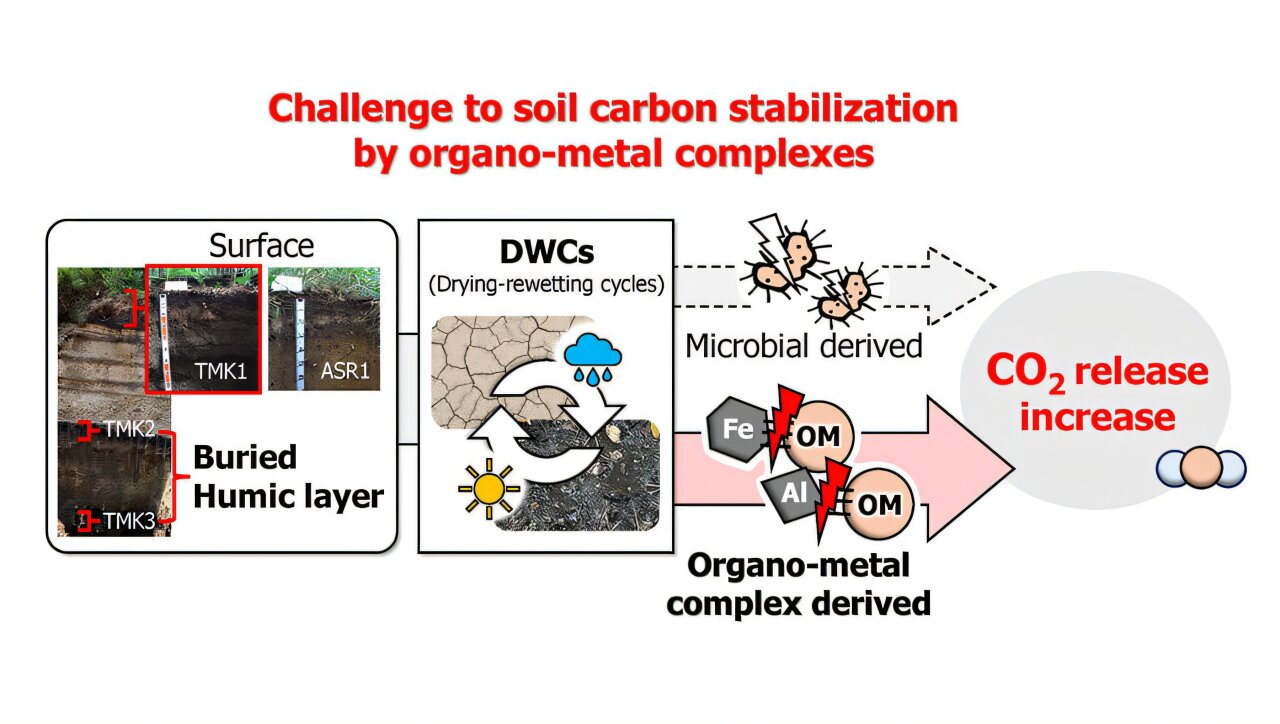
Laboratory experiments reveal new mechanism
Scientists conducted incubation tests using surface soils and buried layers collected from Hokkaido forests. The results showed that repeated cycles of extreme drying followed by rewetting substantially increased carbon dioxide release. This increase was far greater than what microbial biomass alone could explain.
Buried horizons show higher impact
The study focused on buried humic horizons which are former surface soils covered by volcanic ash. In these deeper layers, the acceleration of carbon breakdown exceeded expectations based on traditional microbial models. The findings suggest reactive metal-organic complex components break down faster during these weather cycles.
Study published in journal
The research group released their findings in the journal Progress in Earth and Planetary Science. These results improve predictions regarding how climate change affects global soil carbon dynamics. Understanding this process is vital because natural soil emissions exceed human-made carbon dioxide output.
Reported by one outlet
Only one outlet has published this. Nothing here has been checked against a second report, so read it as that outlet's account and follow the link below for the original.
Reported by
1 independent outlet. Headline as published. Links open the original report.