What Happens When the Second Door Closes?
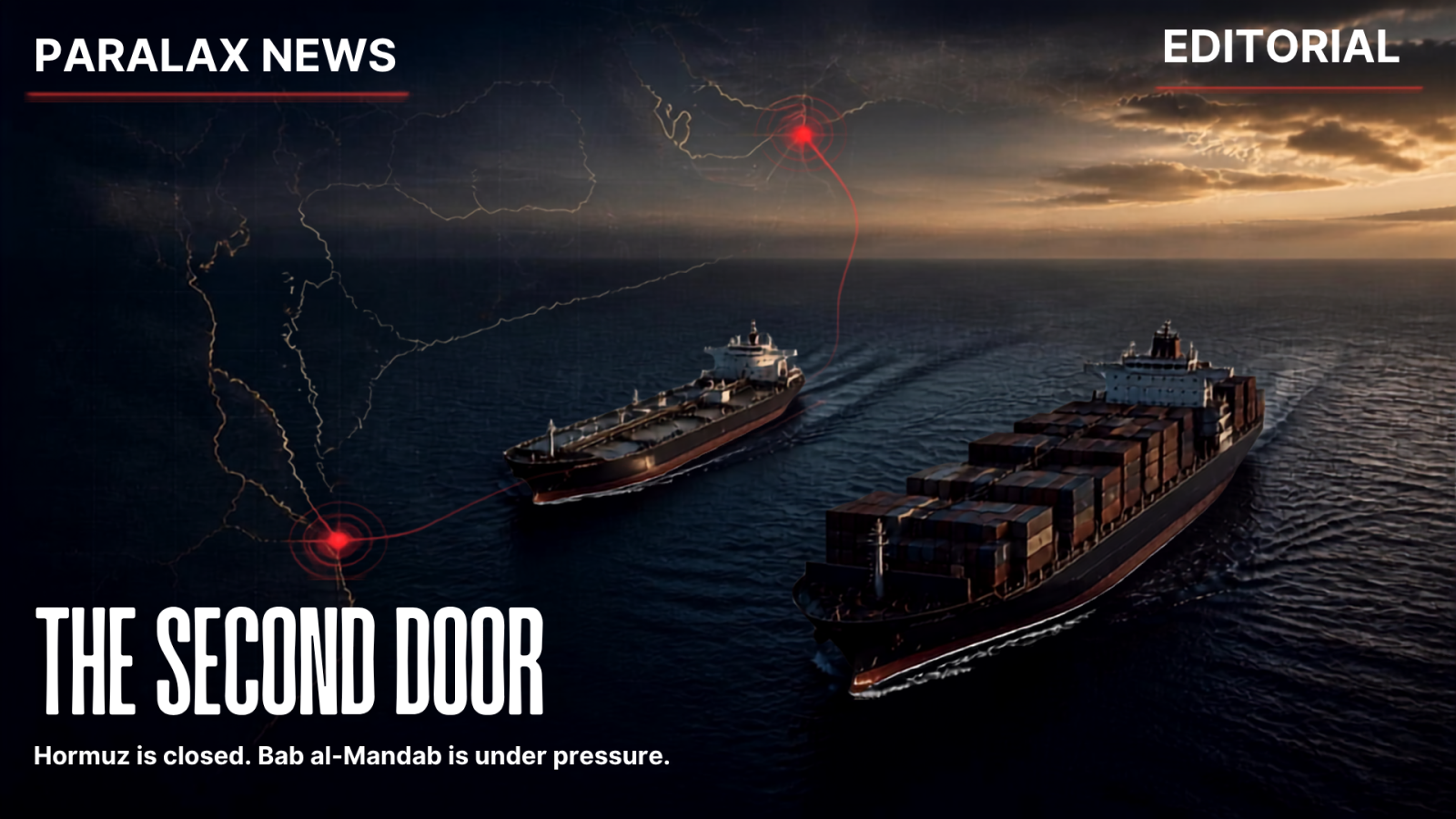
With the Strait of Hormuz closed and the Houthis tightening their position around Bab al-Mandab, the global economy is confronting a more difficult question than the price of oil: how much redundancy is left in the world’s trading system?
The global economy has long depended on a simple assumption: if one major trade route becomes unsafe, ships can find another.
That assumption is now being tested.
The Houthi seizure of Perim Island, also known as Mayun, at the southern entrance to the Red Sea has increased the risks around the Bab al-Mandab Strait at a moment when the Strait of Hormuz is closed as a result of the U.S. war against Iran.
The distinction matters. Perim’s capture does not mean Bab al-Mandab itself has been formally closed. But control of the island gives the Houthis a strategically important position overlooking a narrow waterway through which energy and commercial traffic moves between the Indian Ocean, the Red Sea and the Suez Canal.
That matters because the usual alternative is now under pressure.
The Strait of Hormuz, the principal maritime outlet for Gulf energy, is closed. Before the war, it handled about 125 commercial vessels a day and carried roughly one-fifth of the world’s daily crude oil and liquefied natural gas supplies. On September 10, only seven commercial vessels were recorded passing through the strait, according to preliminary ship-tracking data cited by Reuters.
The closure has forced Gulf producers and their customers to rely on whatever alternatives remain.
Saudi Arabia has been particularly exposed. Its East-West pipeline is designed to provide an alternative route for exporting crude without sending it through Hormuz. But Saudi Arabia shut the pipeline after it was targeted in a drone attack. Reuters reported that the pipeline had been transporting between 4 million and 5 million barrels of oil a day, or roughly 4% to 5% of global supply.
The significance is difficult to miss. An energy system can tolerate the loss of one route if other routes remain reliable. It becomes much more vulnerable when the alternatives are threatened at the same time.
Oil markets are already reflecting that uncertainty.
Brent crude settled at $104.61 a barrel on Friday, while U.S. West Texas Intermediate finished at $100.05. Brent remained on track for a weekly gain of more than 8%, despite Friday’s decline. The market has been responding not only to lost supply, but to the growing difficulty and cost of moving oil through the region.
The immediate temptation is to focus on whether oil reaches $110, $120 or some higher figure.
That misses the larger problem.
A prolonged disruption around Bab al-Mandab would not necessarily remove millions of barrels of oil from the global market overnight. Ships can take longer routes around the Cape of Good Hope. Producers can use alternative ports and pipelines. Buyers can draw on inventories.
But every workaround has a cost.
A vessel travelling around Africa takes longer to reach Europe. It consumes more fuel, ties up shipping capacity and can face higher insurance costs. The same problem affects container ships carrying manufactured goods, machinery, food and raw materials.
The Red Sea crisis has already demonstrated the consequences. Shipping through Bab al-Mandab fell sharply after Houthi attacks caused carriers to divert around Africa. The Associated Press has reported that traffic through the Red Sea declined by roughly 60%.
The economic effect therefore extends well beyond crude oil.
Higher energy prices raise the cost of transport, aviation, agriculture and manufacturing. Longer shipping routes increase freight costs. Businesses eventually pass at least part of those costs to consumers.
There is already evidence of that pressure. Reuters reported this week that U.S. diesel prices had risen above $6 a gallon for the first time, while European policymakers warned that continued energy-price increases could add to inflationary pressure.
For central banks, that creates a difficult problem. An energy shock can push inflation higher at the same time that expensive fuel and transport weaken economic growth. Policymakers then face pressure to keep interest rates higher for longer, even as businesses and households are already absorbing higher costs.
The impact would not be evenly distributed.
Europe is particularly exposed to disruption around the Suez route. Asian economies remain heavily dependent on Gulf energy. China, India, Japan and South Korea are among the world’s largest energy importers and would all be exposed to a prolonged disruption in Middle Eastern shipping.
The United States is better positioned than many countries because of its large domestic energy industry. But it is not isolated from a global oil market. A barrel of crude does not become cheaper simply because it is produced closer to an American refinery.
Pakistan has fewer buffers.
As a major energy importer, Pakistan is vulnerable to higher international oil prices, higher freight costs and renewed pressure on its external accounts. If global energy prices rise while the rupee weakens against the dollar, the effect on domestic fuel and transport costs can be amplified.
Yet the greatest danger may not be an immediate shortage of oil.
It is the erosion of confidence in the routes that carry it.
Companies can adjust to expensive oil. They can adjust to temporary delays. What becomes much harder to absorb is a trading system in which major maritime corridors can no longer be treated as dependable.
That changes how companies manage inventories. It changes insurance premiums. It changes shipping schedules and energy contracts. It encourages governments to hold larger strategic reserves and businesses to build more expensive supply-chain alternatives.
The cost is paid even when no formal blockade exists.
This is why Perim matters.
The island itself is small. Its strategic value is not.
Hormuz is one of the world’s most important energy chokepoints. Bab al-Mandab connects the Red Sea and Suez route to the Indian Ocean. Together, they form part of a maritime system on which the movement of energy and goods between the Gulf, Asia and Europe depends.
For years, the assumption was that if one route became dangerous, another could absorb some of the pressure.
That assumption is becoming harder to defend.
The global economy does not need both straits to be formally closed before the consequences become serious. It only needs one to be closed and the other to become unreliable.
Hormuz is already closed.
The question now is whether the second door can remain open.