Cornell researchers develop chip-based laser cooling for quantum computers
Researchers at Cornell University published findings on November 9 in PRX Quantum regarding a new chip-based laser cooling technique for trapped-ion quantum computers.
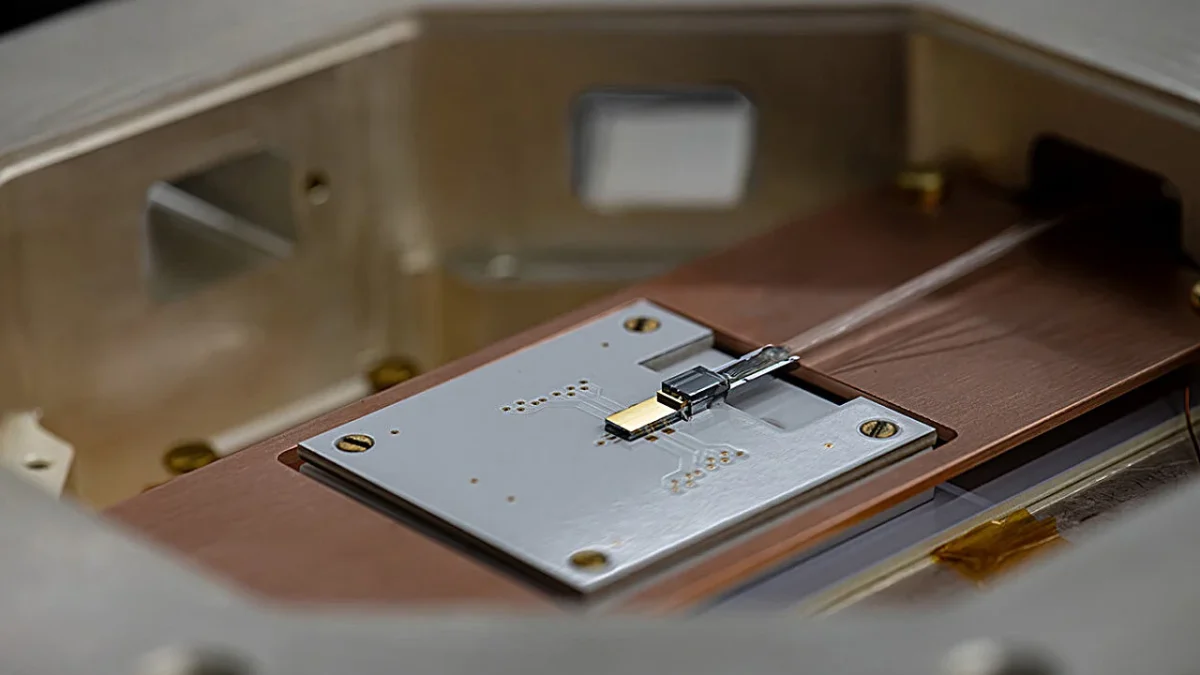
New method cools atomic motion
Karan Mehta, an assistant professor of electrical and computer engineering at Cornell Duffield College of Engineering who heads the team, showed a particular advancement. They used specially designed laser beams delivered through a microfabricated chip to cool multiple types of atomic motion simultaneously. By directing light along tiny routes within the chip containing separate atoms, this method establishes a standing wave configuration. The system efficiently extracts energy from the ion's movement by placing the confined calcium particle where light intensity is lowest.
Cooling time drops significantly
By applying electromagnetically induced transparency cooling, the team reduced the ion's specific movement to near its quantum ground state within roughly 150 microseconds. Such progress stands in contrast to the roughly 500 microseconds achieved by conventional lasers used by other teams before. All three measured modes of the ion's motion, covering a frequency span of about 5 megahertz, were cooled at once by this technique. Standard methods frequently need distinct cooling steps for various motion types, a step the new approach eliminates.
Students implemented experimental design
Doctoral student Zhenzhong Xing developed the theoretical predictions that guided the entire project while Hamim Mahmud Rivy co-authored the initial work. Xing and Rivy implemented the techniques and experiments to translate earlier modeling into an experimental demonstration for the journal. Chips managed to process light ranging from ultraviolet through near-infrared wavelengths even when functioning at successful cryogenic temperatures thanks to the packaging. This ability is important since ions are able to oscillate across three dimensions, with each axis potentially having its own unique frequency.
Reported by one outlet
Only one outlet has published this. Nothing here has been checked against a second report, so read it as that outlet's account and follow the link below for the original.
Reported by
1 independent outlet. Headline as published. Links open the original report.