Unstable plasma heats itself with waves in Large Helical Device
Researchers at the Large Helical Device demonstrated that unstable plasma generates waves which subsequently heat the plasma itself.
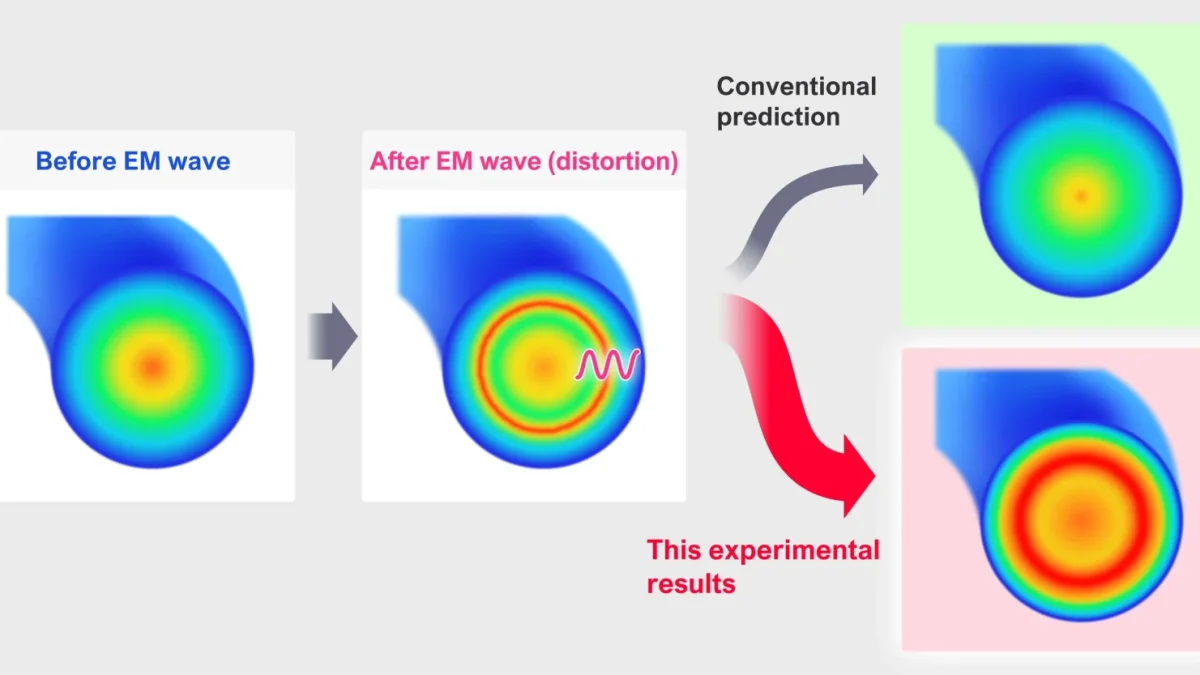
Experiments verify self-heating mechanism
Scientists led by Professor Katsumi Ida used the Large Helical Device to observe a specific heating process. Previously, researchers believed that plasma instability caused energy loss and a temperature drop in the chamber. The team deliberately created unstable conditions instead of trying to suppress them immediately. Their analysis showed that waves generated during these instabilities actually increased the plasma temperature. This finding contradicts the long-held view that such waves only cool the fusion fuel.
Particle motion drives temperature rise
The study tracked how particle motion changed after waves distorted the distribution function within the device. After the distortion returned to normal, the spread of particle motion increased significantly across the chamber. This increase in spread indicates that the plasma temperature had risen despite the initial instability event. The sequence confirmed that waves generated by the plasma heat it rather than draining its energy.
New path for fusion power
This discovery offers a new perspective on how fusion reactors maintain high temperatures without constant external heating. Large-scale facilities like ITER will need this understanding to demonstrate full self-heating around the year 2040. Current experiments cannot yet show the entire self-heating process required for commercial nuclear fusion energy generation. Understanding these mechanisms is essential for developing sustainable electricity sources that emit no carbon dioxide.
Reported by one outlet
Only one outlet has published this. Nothing here has been checked against a second report, so read it as that outlet's account and follow the link below for the original.
Reported by
1 independent outlet. Headline as published. Links open the original report.