Sunlike star orbits white dwarf flashing radio waves
Astronomers identified a sunlike G-type star orbiting a white dwarf that emits radio flashes every 7.9 minutes using telescopes in Australia and South Africa.
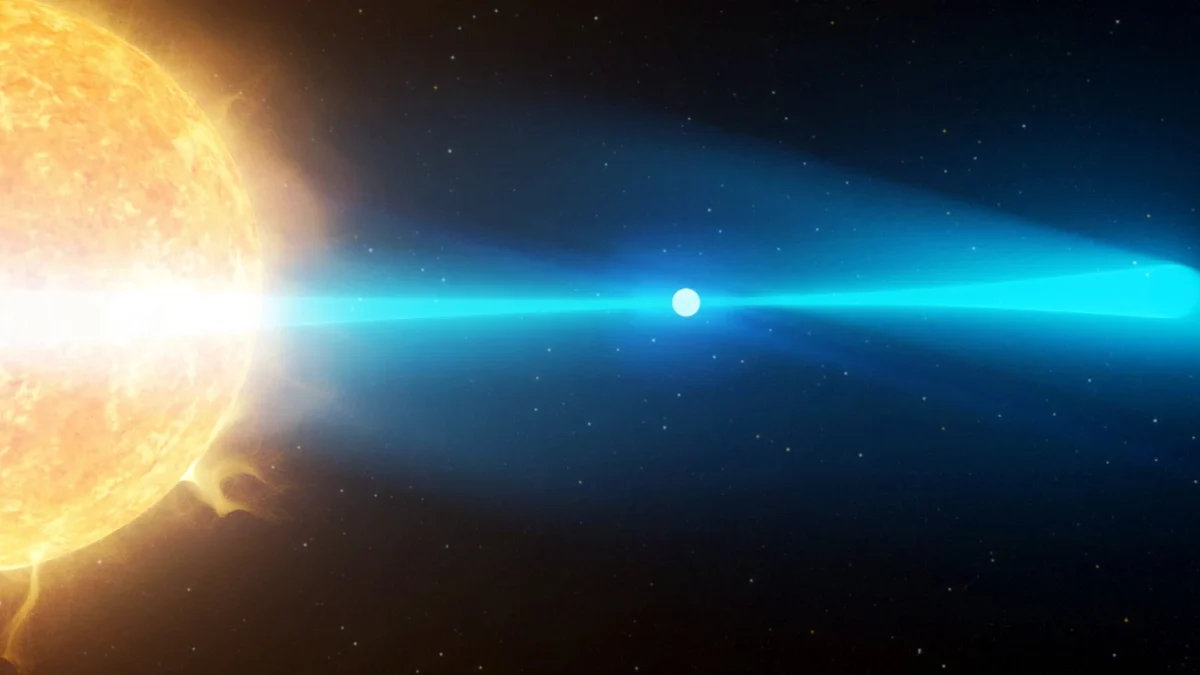
New binary system found
Researchers published findings in Nature Astronomy regarding a unique cosmic object emitting bright radio waves. The signals arrive from a binary system containing a white dwarf paired with a star resembling our sun. This discovery marks the first time such an intermittent broadcaster involves a sunlike partner instead of a red dwarf. Earlier theories suggested slow-spinning neutron stars caused these flashes, but timing data ruled that possibility out completely.
Telescope observations confirm mass
The Murchison Widefield Array in Western Australia detected short flashes arriving like clockwork every 7.9 minutes before they ceased temporarily. Plotting detections revealed a pattern where pulses appear during a six-hour window followed by twenty-six hours of silence. Observations from the MeerKAT telescope located in South Africa identified the origin as a small region of the sky that holds one dim star. Keck telescope measurements in Hawaii showed the sunlike star barely wobbles, proving it is much heavier than its partner.
Orbit calculations reveal weight
Pulse arrival times vary up to four seconds due to distance changes as the object swings around its orbit. These variations allow scientists to calculate the size of the orbit and determine how long each revolution takes. Merging these measurements with spectrum data reveals that the pulsing object weighs roughly two-thirds of the sun's mass. The system completes one full orbit every 32 hours while emitting radio waves only when aligned correctly.
Reported by one outlet
Only one outlet has published this. Nothing here has been checked against a second report, so read it as that outlet's account and follow the link below for the original.
Reported by
1 independent outlet. Headline as published. Links open the original report.