Study tracks conflicting emotional cues in dog brains
A research team led by Associate Professor Takatomi Kubo at Nara Institute of Science and Technology published findings on August 22, 2026 regarding how dogs process mismatched human emotions.
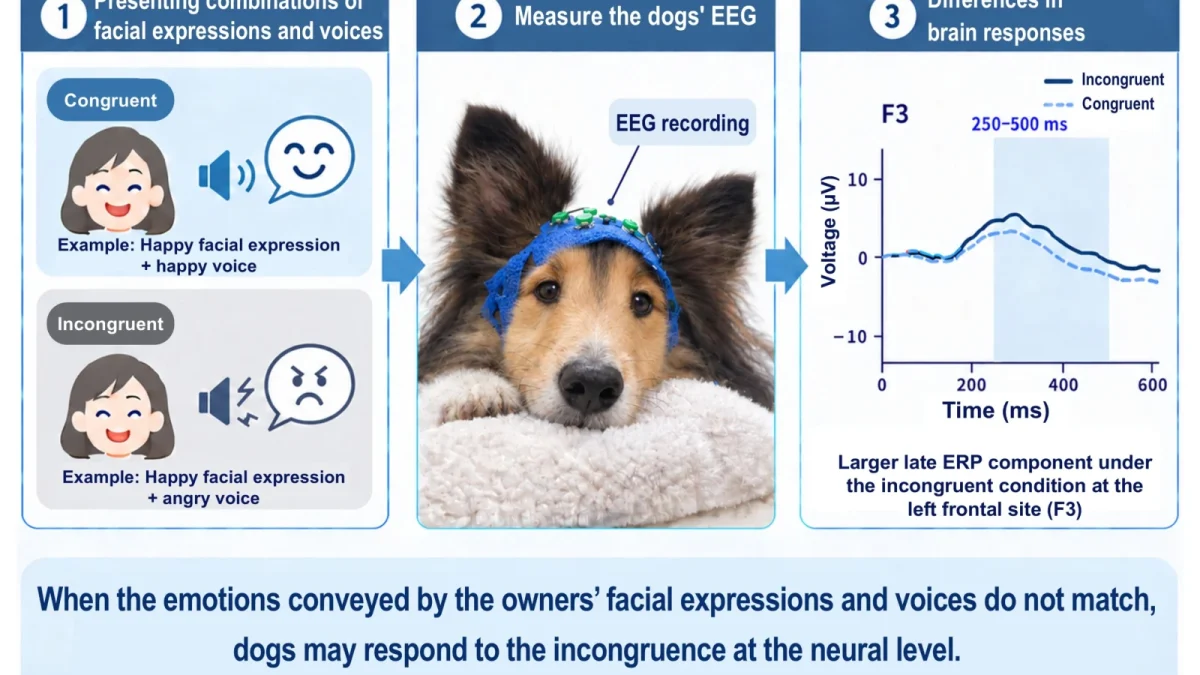
EEG records brain activity in three dogs
Scientists captured brainwave data from three pets that stayed motionless during a session with a specialized EEG headband. Every canine observed video segments that paired images of their human companion showing joy or rage alongside audio tracks containing the person's vocalizations conveying those feelings. Subsequently, the investigators examined brain responses to see if facial and vocal emotions aligned or contradicted each other. In short, ERPs represent localized shifts in electrical activity that correspond to particular events like visual or auditory signals.
Mismatched cues trigger stronger brain responses
Analysis of the data revealed that incongruent emotional signals produced more prominent late ERPs compared to congruent ones, especially within the 250 to 500 ms window following voice clip playback. The largest consistency appeared at a specific frontal electrode, yet where significant ERP responses occurred differed among each dog. According to Kubo, these early results indicate that dogs might possess neural sensitivity regarding mismatched audiovisual emotional signals provided by their owners. The observed responses potentially reflect increased attentional, integrative or expectancy-violation processes during the interaction.
Small sample leaves key questions open
Because the study included just three pet dogs, the researchers state that these results by themselves do not prove that dogs specifically combine emotional data from different senses. The group likewise could not verify whether the detected reactions stemmed simply from having their anticipated outcomes interrupted while conducting the study. Nevertheless, the study creates a practical EEG model to guide upcoming investigations into how dogs handle audiovisual emotions. Upcoming research with additional canines and behavioral assessments will ultimately enhance comprehension of the impact of human communication on dogs during daily care and training.
Reported by one outlet
Only one outlet has published this. Nothing here has been checked against a second report, so read it as that outlet's account and follow the link below for the original.
Reported by
1 independent outlet. Headline as published. Links open the original report.