Researchers link sunspot fibrils to solar waves
A team from the Chinese Academy of Sciences published findings on Jan 10 2023 linking dynamic fibrils around a sunspot to slow magnetoacoustic waves.
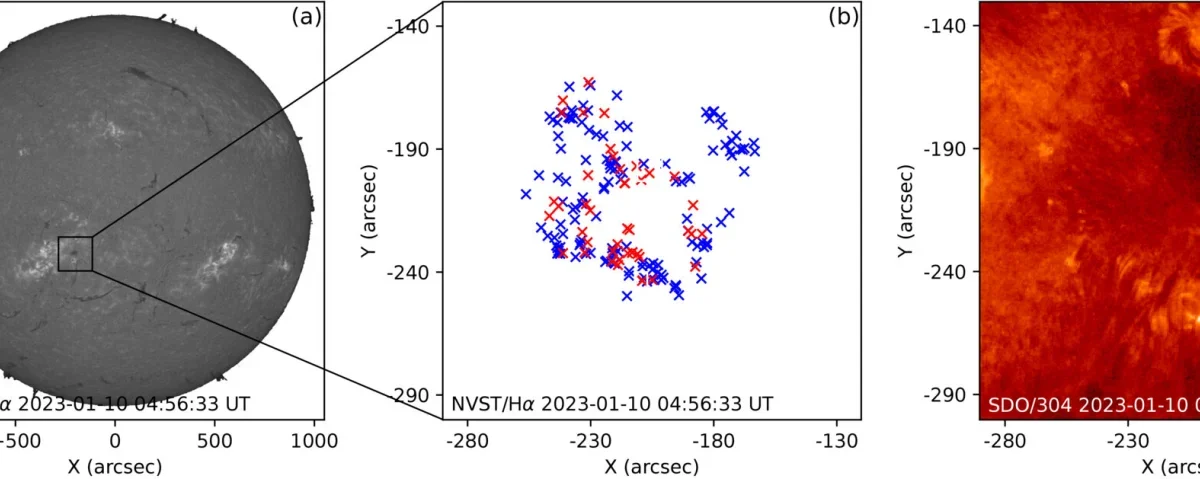
Observations reveal wave connections
The research group used high-resolution data from the New Vacuum Solar Telescope to study NOAA active region 13182. They identified 176 dynamic fibrils within the solar chromosphere during observations made on Jan 10 2023. Of these structures 132 showed single-parabolic motion while 44 displayed multi-parabolic movement patterns. The analysis measured mean deceleration at 120 plus or minus 43 meters per second squared.
Magnetic fields shape motion
Deceleration showed a significant positive correlation with maximum velocity reaching 15.9 plus or minus 4.5 kilometers per second. The study found that regions with more vertical magnetic fields produced larger decelerations and shorter oscillation periods. Conversely areas with horizontal magnetic fields behaved in the opposite manner regarding these physical properties. This difference likely stems from how magnetic field inclination affects the acoustic cutoff frequency.
Energy transport implications
Spatiotemporal relationships between multi-parabolic events and running penumbral waves point to a physical connection between them. The dominant oscillation periods for these events matched closely at 287 seconds and 263 seconds respectively. Data gathered across multiple wavelengths show signs spanning the chromosphere, the transition region, and up to the corona. These findings provide new evidence for understanding energy transport and heating in the solar atmosphere.
Reported by one outlet
Only one outlet has published this. Nothing here has been checked against a second report, so read it as that outlet's account and follow the link below for the original.
Reported by
1 independent outlet. Headline as published. Links open the original report.