Researchers create organic catalyst with longer charge lifetime for solar hydrogen
Scientists from the Chinese Academy of Sciences developed a new coumarin-linked covalent organic framework to improve solar hydrogen production efficiency.
New material structure improves efficiency
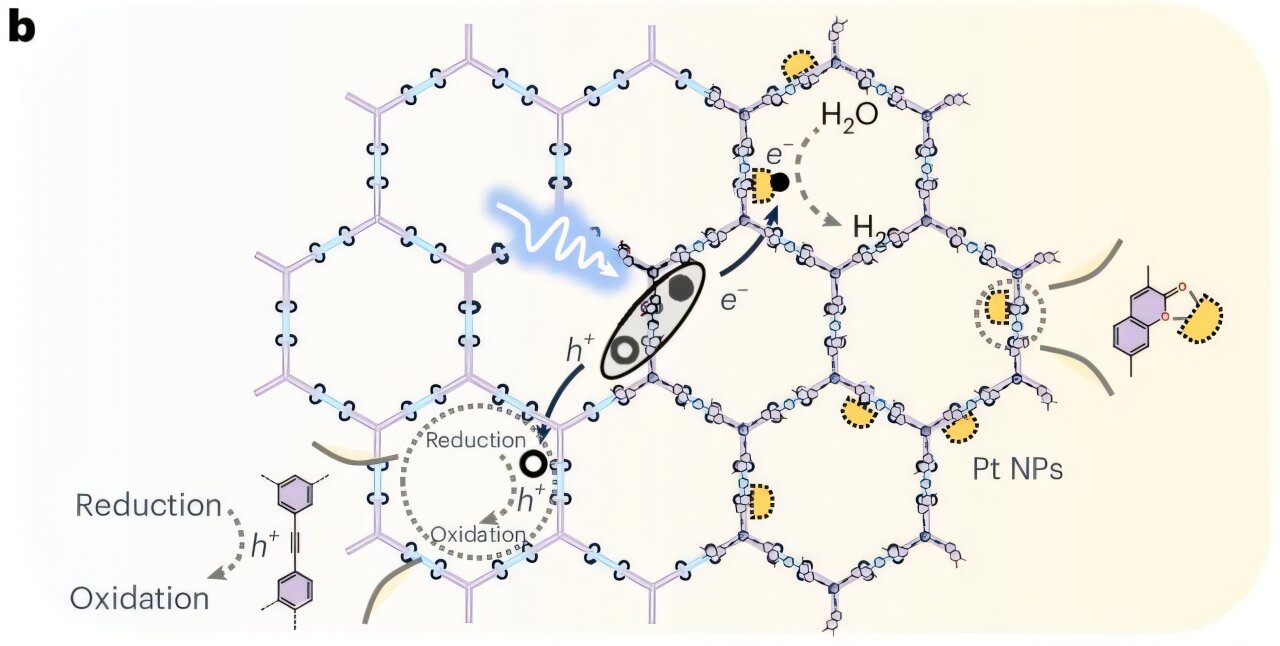
Researchers at the Ningbo Institute of Materials Technology and Engineering collaborated with colleagues from the Technical Institute of Physics and Chemistry. They created a coumarin-linked covalent organic framework that allows for high-efficiency photocatalytic water splitting. This method converts solar energy into hydrogen to help address global energy needs.
Rigid linkages stop energy loss
Conventional conjugated COFs often suffer from flexible linkages that rotate out of plane and disrupt electron flow. The team introduced a rigid, planar coumarin linkage through a one-pot polycondensation strategy to fix this issue. This change reduces energy dissipation and prevents the rapid recombination of photogenerated electrons and holes.
Study published in Nature Synthesis
The study was published in the journal Nature Synthesis by the Chinese Academy of Sciences team. The new material offers a 1,000-fold longer charge lifetime compared to previous organic photocatalysts. This extension significantly boosts the speed at which solar hydrogen can be produced.
Reported by one outlet
Only one outlet has published this. Nothing here has been checked against a second report, so read it as that outlet's account and follow the link below for the original.
Reported by
1 independent outlet. Headline as published. Links open the original report.