JWST finds early black hole outpacing host galaxy growth
Astronomers using the James Webb Space Telescope identified a possible black hole in MARTA 3887 that grew faster than its host galaxy roughly 12 billion years ago.
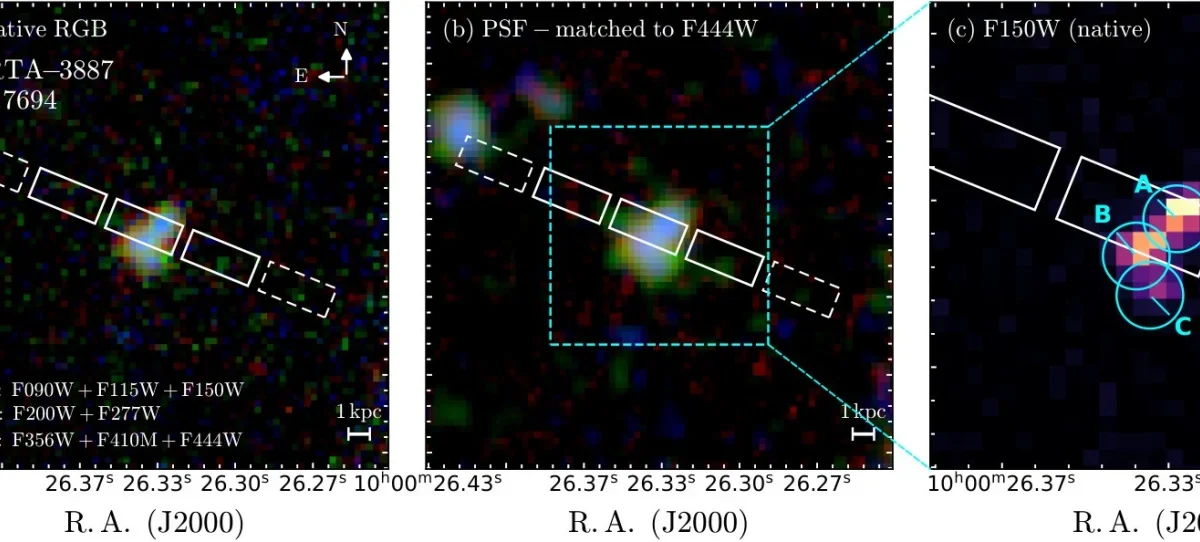
New multiwavelength study reveals anomaly
Researchers merged spectral analysis from the James Webb Space Telescope with Hubble images and historical records from the Very Large Telescope. This analysis focused on MARTA 3887, a clumpy metal-poor galaxy observed when the universe was young. The object at the center shows signs of being an overmassive black hole rather than ordinary stellar activity.
Mass estimates show unusual ratio
Mirko Curti of the INAF observatory in Bologna led the team that gathered these diverse lines of evidence. They detected a wide hydrogen-alpha line indicating gas moving at about 1,270 kilometers per second. The black hole mass is roughly 3.3 million suns while the galaxy contains 145 million solar masses in stars.
Growth rate defies local norms
This relationship places the object approximately 2 dex above the local relation seen in nearby galaxies today. Such a ratio means the black hole mass is about 100 times higher than expected for its host. Researchers suggest black-hole growth has clearly outpaced the assembly of the observed stellar component in this specific case.
Reported by one outlet
Only one outlet has published this. Nothing here has been checked against a second report, so read it as that outlet's account and follow the link below for the original.
Reported by
1 independent outlet. Headline as published. Links open the original report.