International team shows classical light drives quantum photon thermalization
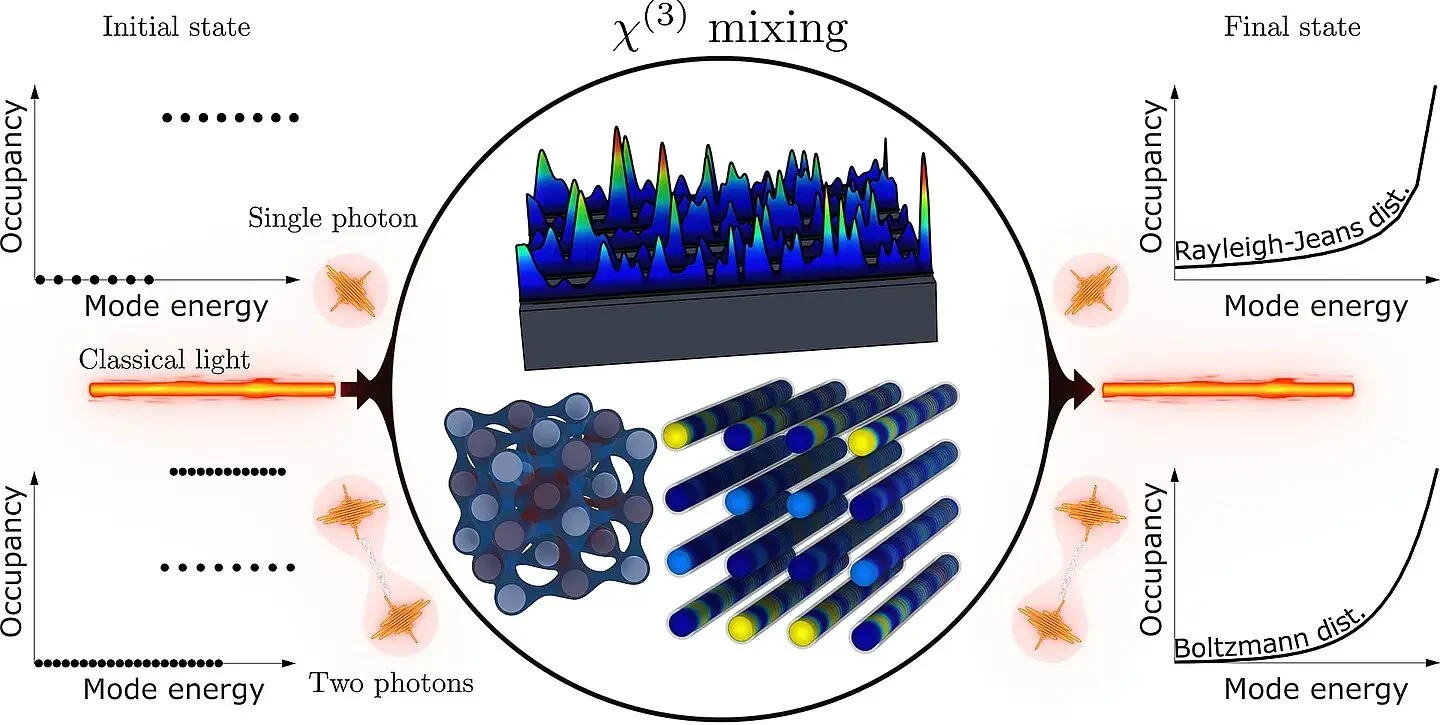
Scientists from Saint Louis University, the Max Born Institute and Humboldt-Universität zu Berlin published a study in Science Advances showing how classical nonlinear dynamics can cause single-photon states to thermalize.
New method for simulating quantum systems
A global partnership shows that classical nonlinear dynamics can push single- and two-photon states toward thermalization. Such progress creates fresh pathways for modeling intricate quantum many-body systems using reachable optical setups. Photons usually lack direct interactions because conventional media show vanishingly small nonlinear responses at ultralow light intensities. The research team proved that multimode nonlinear optical platforms can induce effective quantum interactions between photons instead.
Bridging macroscopic optics and quantum mechanics
This research examines situations in which quantum light travels near strong classical light fields inside multimode nonlinear optical systems. Strict numerical tests showed that the embedded states neither keep their starting conditions nor experience unchecked decoherence. Instead, they thermalize through the emergence of characteristic statistical distributions matching Rayleigh-Jeans and Boltzmann distributions. Such a method sidesteps the need for rare ultrastrong single-photon nonlinear materials that are well known for being hard to fabricate and scale.
Using standard classical optical structures
This new framework enables the group to connect microscopic quantum mechanics with macroscopic nonlinear optics. Instead of relying on exotic substances, their approach secures effective quantum thermalization by employing standard and easily accessible classical optical components. Such an approach offers a robust means to model quantum phenomena that were once thought unreachable within optical configurations.
Reported by one outlet
Only one outlet has published this. Nothing here has been checked against a second report, so read it as that outlet's account and follow the link below for the original.
Reported by
1 independent outlet. Headline as published. Links open the original report.