West Virginia team finds how electrons gain energy during magnetic reconnection
Researchers at West Virginia University published new findings on November 28, 2026, showing that lower-hybrid drift waves transfer energy to electrons during magnetic reconnection.
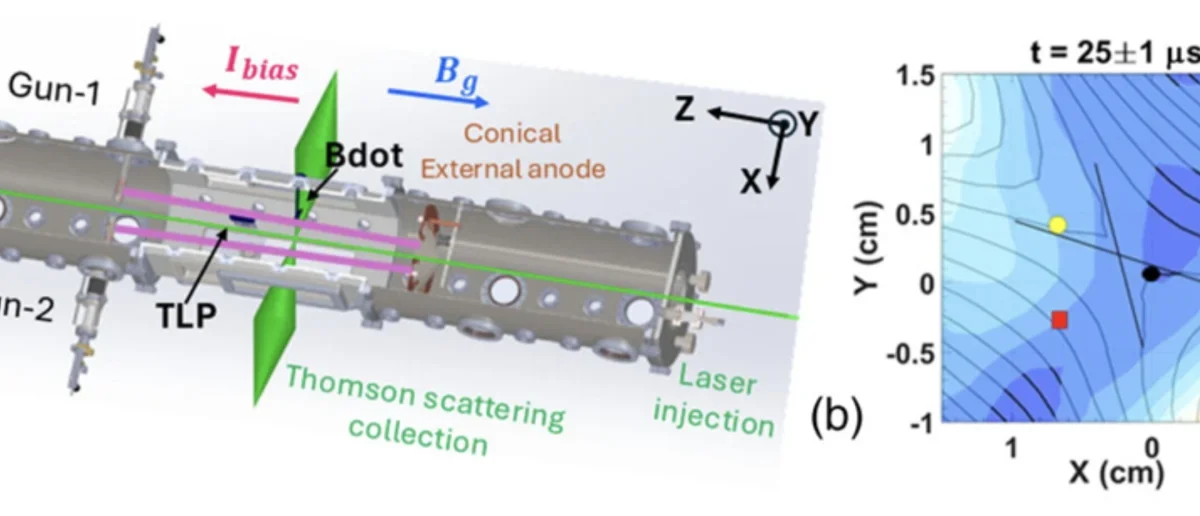
Lab experiment reveals electron heating mechanism
Sonu Yadav and his colleagues at West Virginia University reported findings in Physical Review Letters detailing the process by which electrons acquire energy. The study provides direct evidence that lower-hybrid drift waves carry this energy transfer during the process. These waves form at sharp boundaries where plasma density drops steeply over a short distance. Physicists previously struggled to explain exactly how stored magnetic energy moves to particles within the plasma.
Scientists used PHASMA facility for tests
The researchers utilized the PHASMA facility, which contains a vacuum chamber almost 5 meters long. Researchers formed two spiraling shafts of magnetized helium plasma and forced them into contact to initiate reconnection events. Every merger unfolded with nearly identical results, enabling the team to repeat the experiment numerous times. In some runs, they measured waves with electrical probes while recording electron speeds by measuring laser light scattering.
Data matches theoretical predictions closely
When the waves increased in size, additional electron groups emerged traveling at velocities identical to the wave progression along the magnetic field. Within approximately two microseconds, the peaks expand to form flat areas within the speed spectrum of the electrons. Identical electron signatures were also detected at two separate locations on the reconnection boundary. Combined findings indicate that these waves function as intermediaries transferring magnetic energy to electrons.
Reported by one outlet
Only one outlet has published this. Nothing here has been checked against a second report, so read it as that outlet's account and follow the link below for the original.
Reported by
1 independent outlet. Headline as published. Links open the original report.