Two teams find symmetry shortcut for magnetic patterns
Independent research teams in China and Japan have developed a symmetry-based method to narrow the search for hidden magnetic spin patterns in crystals.
Researchers simplify magnetic pattern search
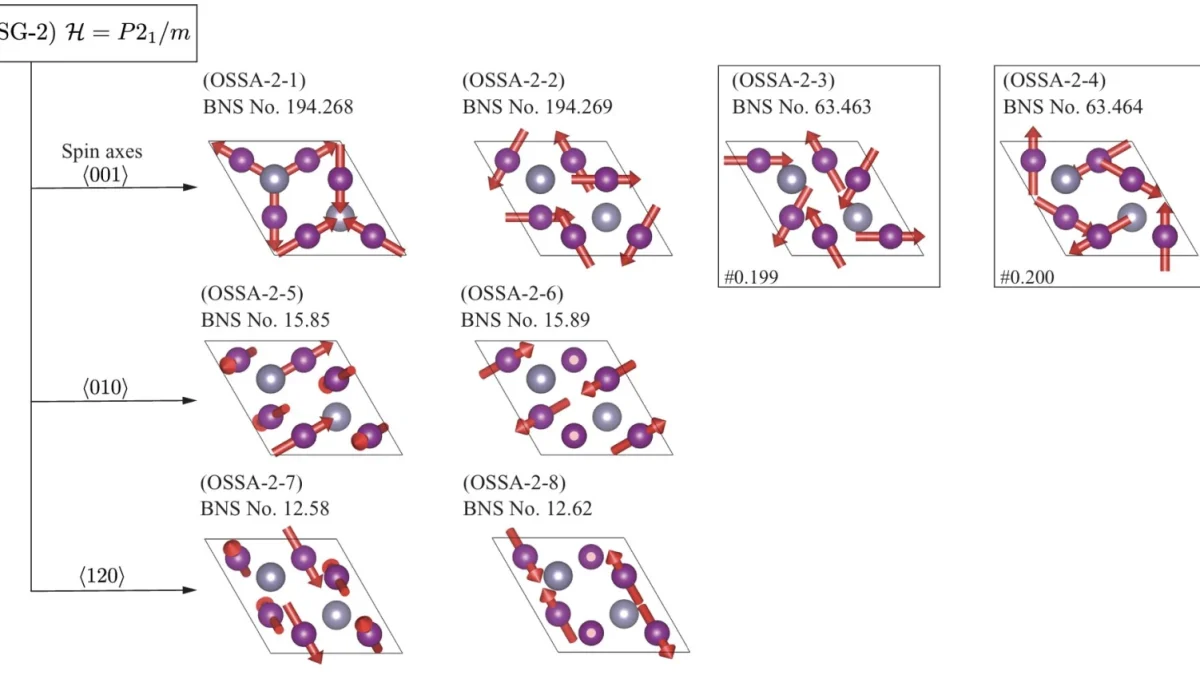
Researchers Qihang Liu from the Southern University of Science and Technology in China alongside Takuya Nomoto at Tokyo Metropolitan University in Japan have shown a method to greatly lower the count of candidate spin patterns. Both teams published their findings in Physical Review X after using computer simulations to rank potential arrangements based on symmetry and spin-orbit coupling. The approach avoids testing every possible pattern individually, which would be impossible given the vast number of plausible configurations in single crystals.
Methods differ but results align
Before setting a specific repeat length, Liu's group looked for patterns that recur across areas as large as four times the fundamental unit of a crystal. Their method successfully reproduced known spin structures in three distinct magnets, including MnTe, Mn₃Sn, and CoNb₃S₆, recovering reported magnetic structures for 73% of 1,178 screened materials. Nomoto's group accelerated their second simulation stage by reusing electron arrangements calculated earlier, achieving the lowest energy result in 83% of 271 cases where repeat length was known.
Future tests aim to predict order
Researchers intend to conduct more rigorous experiments by forecasting outcomes based on crystal structures recorded prior to the onset of magnetic ordering. They intend to compare these early predictions with later diffraction measurements to validate the accuracy of their symmetry-based filtering technique. If successful, this strategy could open new routes for discovering materials suitable for spin-based memory and electronic applications.
Reported by one outlet
Only one outlet has published this. Nothing here has been checked against a second report, so read it as that outlet's account and follow the link below for the original.
Reported by
1 independent outlet. Headline as published. Links open the original report.