SeoulTech team develops modular liver-on-a-chip for chemical toxicity testing
Researchers at Seoul National University of Science and Technology published a study on Sept. 15, 2026, describing a new modular liver-on-a-chip platform designed to assess environmental chemical toxicity.
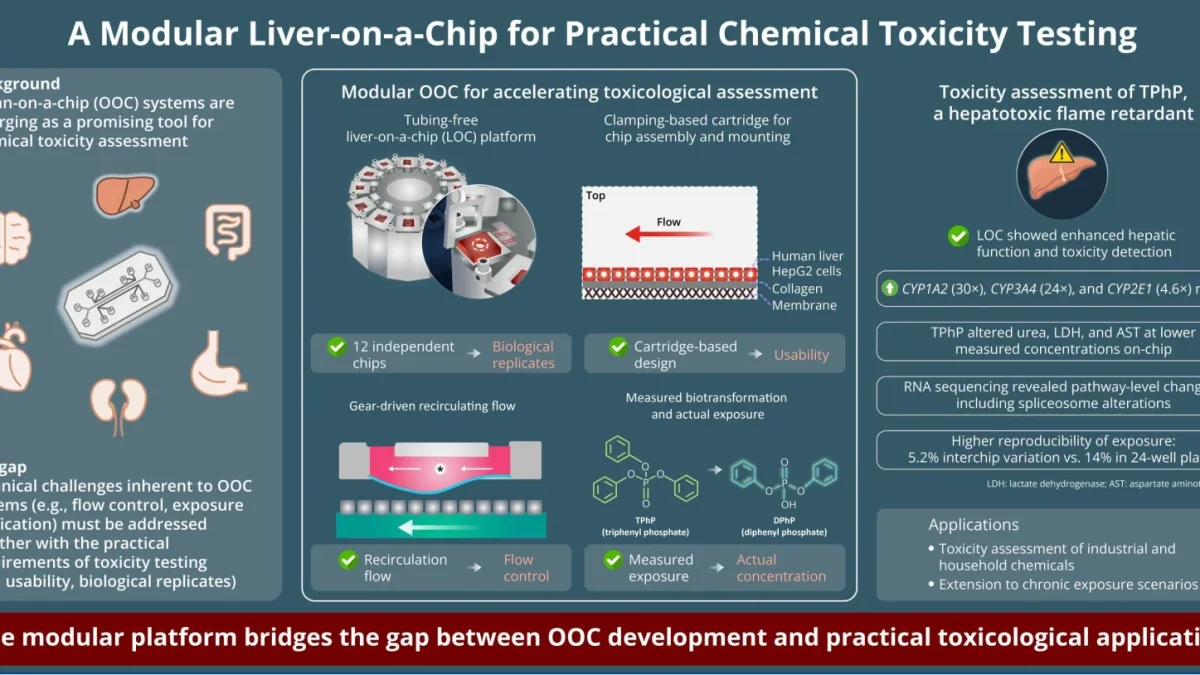
Tubing-free design improves flow control
The research team led by Professor Ki-Tae Kim and doctoral candidate Jiyun Kang created a system that accommodates twelve cartridge-based chips in parallel. This modular liver-on-a-chip platform features a tubing-free design where each chip uses an easy-to-use clamping-based sealing mechanism for secure connections. One LOC chip houses human liver HepG2 cultures and includes independent unidirectional recirculating flow managed by gear-based peristaltic pumping. In contrast to fixed plate systems, this recirculating flow constantly subjects cells to the circulating medium and allows for controlled, reproducible chemical exposure that more accurately mirrors biological conditions.
Platform detects toxicity at lower doses
Testing revealed that the LOC platform exhibited superior hepatic performance compared to static plate cultures, which displayed significantly elevated expression of CYP1A2, CYP3A4 and CYP2E1 mRNA. Scientists applied the system to assess how triphenyl phosphate, a widely used flame retardant found in home goods and associated with liver damage, affects hepatotoxicity. When exposed to the substance, cartridge modules showed high reproducibility and uniform chemical distribution during experiments. Following exposure, the platform exhibited shifts in hepatic phenotypic marker levels such as urea, lactate dehydrogenase and aspartate aminotransferase at concentrations lower than those found in plate-based cultures.
RNA sequencing reveals biological pathways
Analysis of RNA from HepG2 cells exposed to triphenyl phosphate showed alterations in biological pathways linked to hepatotoxicity, specifically affecting the spliceosome and inflammatory signaling pathways. In total, trials demonstrated that the system delivers biological replicates without pooling, maintains steady flow regulation, and enables direct assessment of exposure patterns. Professor Kim notes that their system allows for human toxicity evaluation using actual cell exposure data, which facilitates next-generation risk assessment.
Reported by one outlet
Only one outlet has published this. Nothing here has been checked against a second report, so read it as that outlet's account and follow the link below for the original.
Reported by
1 independent outlet. Headline as published. Links open the original report.