Researchers map bonding evolution in carbon-centered gold clusters
A team from Tokyo University of Science and Fuzhou University published findings on carbon-gold cluster bonding in the journal JACS Au.
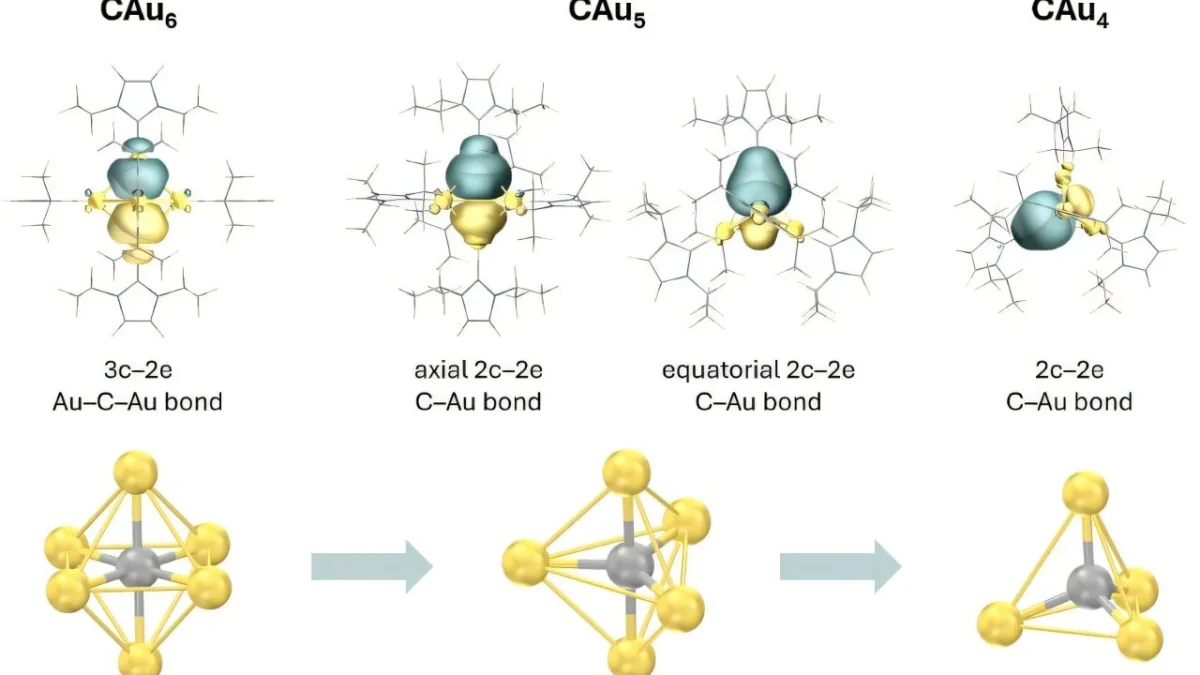
Quantum calculations reveal bond patterns
The collaborative group used quantum chemical calculations to compare clusters with four, five or six gold atoms. They protected these structures with N-heterocyclic carbene or triphenylphosphine ligands during the study. In the six-gold cluster, the central carbon forms three delocalized three-center, two-electron bonds across Au-C-Au units. The four-gold cluster instead contains four conventional two-center, two-electron bonds involving single carbon and gold atoms.
Five-gold cluster acts as intermediate
The five-gold cluster serves as a revealing link between the bonding patterns of the smaller and larger clusters. Its two axial C-Au bonds are classified as two-center, two-electron bonds but resemble three-center bonds in character. Those three equatorial C-Au bonds show typical two-center traits like the ones seen in the four-gold cluster. This arrangement establishes the five-gold species as an intermediate between the localized and delocalized bonding types.
Ligands affect core shape and chirality
The study also examined how surrounding ligands influence the shape of the six-gold cluster core. Smaller ligands generally favor more symmetric core structures while bulkier ligands promote distortion and asymmetric arrangements. The overall chirality of the clusters results from both the distortion of the core and the chirality of the ligands. These findings provide a comprehensive understanding of how gold coordination and ligand choice affect these unusual molecular systems.
Reported by one outlet
Only one outlet has published this. Nothing here has been checked against a second report, so read it as that outlet's account and follow the link below for the original.
Reported by
1 independent outlet. Headline as published. Links open the original report.