Researchers develop noninvasive chip to sort cells by electrical signature
A collaborative team from Singapore and China has created a new microfluidic chip that sorts living cells without labels using sound waves.
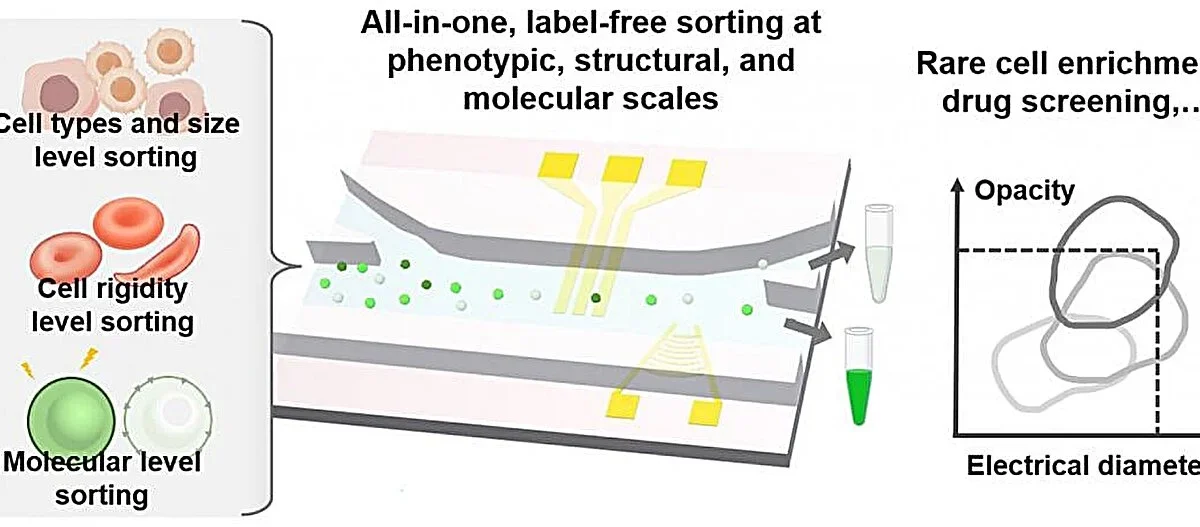
System uses electrodes and sound
The platform integrates pre-focusing, sensing, and manipulation to handle single cells. A viscoelastic fluid lines up cells in a single file before they reach the detection zone. Electrodes interrogate each cell electrically at two frequencies of one and five megahertz. The system records how passing cells change these signals to extract features related to size and behavior. If a cell meets preset criteria, a focused acoustic wave generator nudges it sideways into a collection outlet.
Tests show high purity rates
Researchers tested the platform across three distinct problems involving different cell types. Sorting HeLa cells from EA.hy926 cells based on electrical diameter reached up to 98 percent purity. The system also detected red blood cells whose stiffness changed due to chemical treatments mimicking disease. Most demanding was sorting HEK293T cells engineered with light-sensitive proteins that look structurally identical but differ in charge handling.
Functional signatures enable precise sorting
Ye Ai, an associate professor at Singapore University of Technology and Design, co-authored the research released in Small Methods. The group obtained 98 percent purity using cells of varying sizes that are fairly simple to separate. However, sorting cells based on subtle functional electrical signatures yielded a purity of only 85.4 percent. This result demonstrates the capability to sort cells without obvious size or shape differences.
Reported by one outlet
Only one outlet has published this. Nothing here has been checked against a second report, so read it as that outlet's account and follow the link below for the original.
Reported by
1 independent outlet. Headline as published. Links open the original report.