Paderborn team tests scalable photonic quantum computer performance
Researchers at Paderborn University have published new findings from Germany's first scalable photonic quantum computer regarding its computational resources.
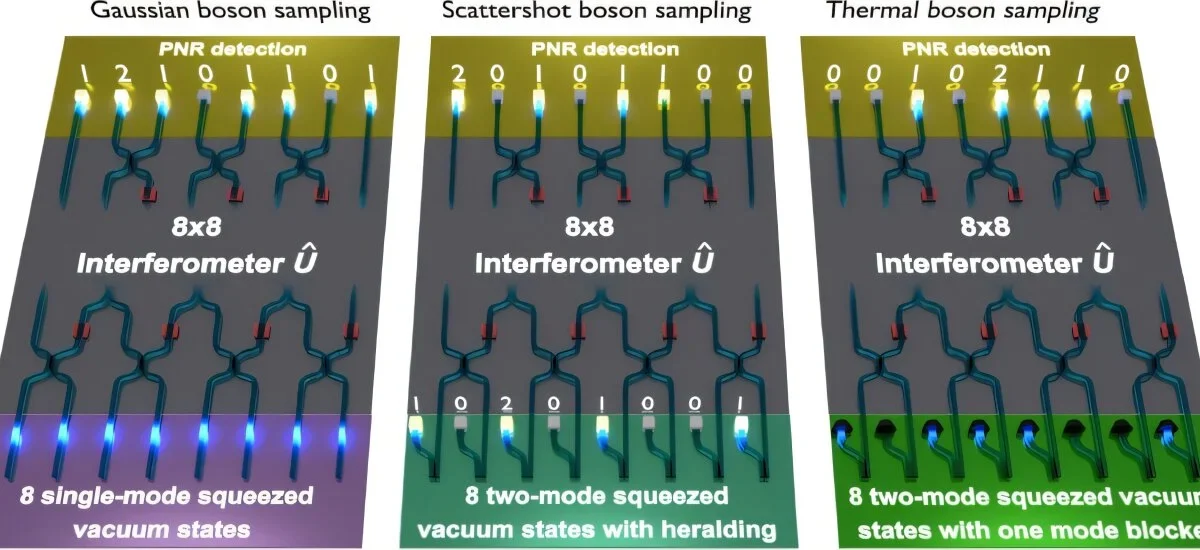
New research on quantum resources
A team led by Dr. Christine Silberhorn investigated which quantum resources most influence device performance. They utilized the Paderborn Quantum Sampler, a Gaussian boson sampler located at the Institute for Photonic Quantum Systems. The group combined expertise in integrated photonics with insights from computer science and theoretical quantum optics. Their work encompassed hardware development alongside new methods for data analysis and interpreting measurement results.
Programmable platform for future use
Dr. Michael Stefszky explained that building useful computers requires understanding properties like squeezed light and entanglement. The system measures points where photons leave a complex photonic network to sample Gaussian bosons. Simulating these results on conventional supercomputers can take thousands of years for large systems. Researchers configured the network for various experiments, turning the device into a flexible research platform.
System currently being expanded
The collaboration involved PhoQS research groups led by Dr. Jan Sperling and Dr. Tim Bartley as well. This Germany-wide partnership focused on evaluating how individual resources contribute to overall capabilities. The system is currently being expanded to handle more complex tasks in the future.
Reported by one outlet
Only one outlet has published this. Nothing here has been checked against a second report, so read it as that outlet's account and follow the link below for the original.
Reported by
1 independent outlet. Headline as published. Links open the original report.