New Study Sets Fundamental Complexity Limit for Quantum Circuit Optimization
Researchers at Kvantify published new findings on the arXiv preprint server establishing that optimizing specific quantum circuits is an NP-complete problem.
Theoretical Barrier Identified for Circuits
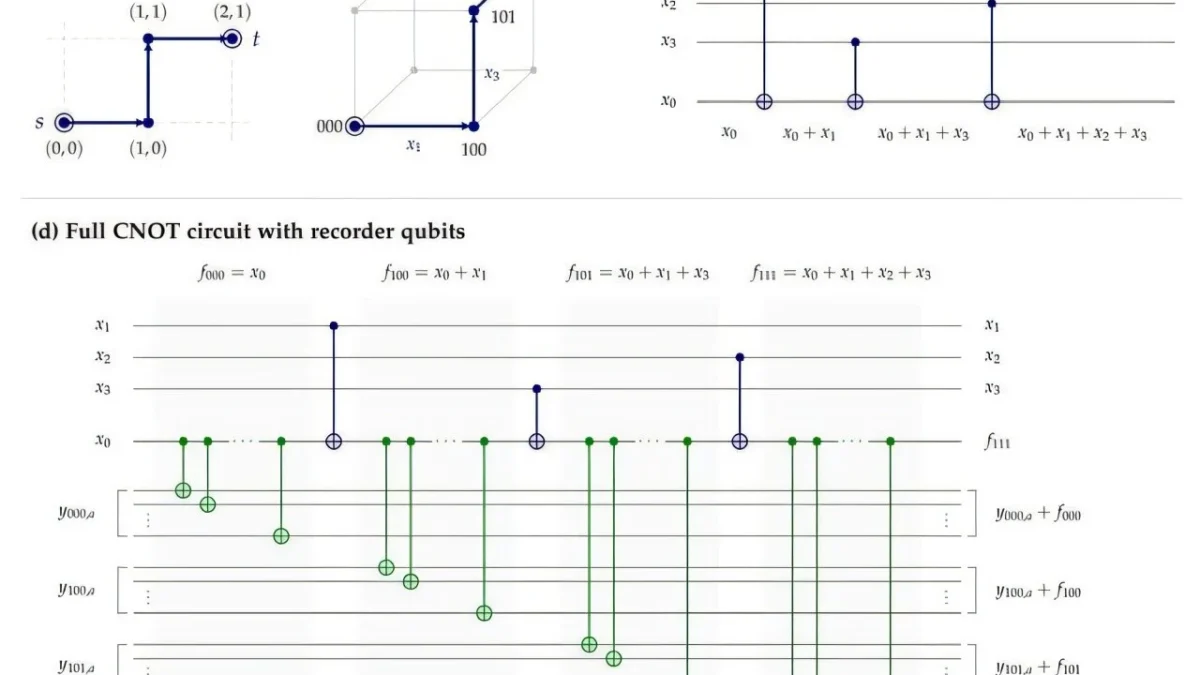
Fresh study confirms that determining if a specific Clifford operator allows implementation with no more than a set count of CNOT gates constitutes an NP-complete problem. This finding applies even when allowing an unlimited number of single-qubit Clifford gates alongside the two-qubit operations. The study proves that verifying a proposed solution remains efficient, yet finding the optimal implementation is computationally difficult. Researchers demonstrated this by translating instances of the Hamiltonian path problem on grid graphs into quantum circuit synthesis challenges.
Relevance to Quantum Algorithms
Clifford circuits are constructed from Hadamard, phase, and controlled-NOT gates and appear in several important components of quantum algorithms. These circuits often represent molecular processes in quantum chemistry applications where individual operations might still allow for combined optimization. Efficient implementation is also vital for quantum measurement procedures that estimate molecular energies through Pauli operator expectation values. Furthermore, quantum error correction protocols rely heavily on these specific circuit structures to function effectively.
Implications for Hardware Design
Current quantum hardware architectures exhibit higher error rates in two-qubit operations compared to single-qubit gates. Reducing the total count of two-qubit gates remains a primary objective for researchers developing practical quantum systems. The new result provides a theoretical explanation for the inherent difficulty in finding the most resource-efficient implementation of these circuits. This complexity limit holds for restricted classes of operators and extends to general settings with alternative gate-cost models.
Reported by one outlet
Only one outlet has published this. Nothing here has been checked against a second report, so read it as that outlet's account and follow the link below for the original.
Reported by
1 independent outlet. Headline as published. Links open the original report.