New study explains Uranus and Neptune magnetic fields
Scientists at The University of Texas at Austin propose a new explanation for the tilted magnetic fields of Uranus and Neptune published in Communications Physics on November 15, 2026.
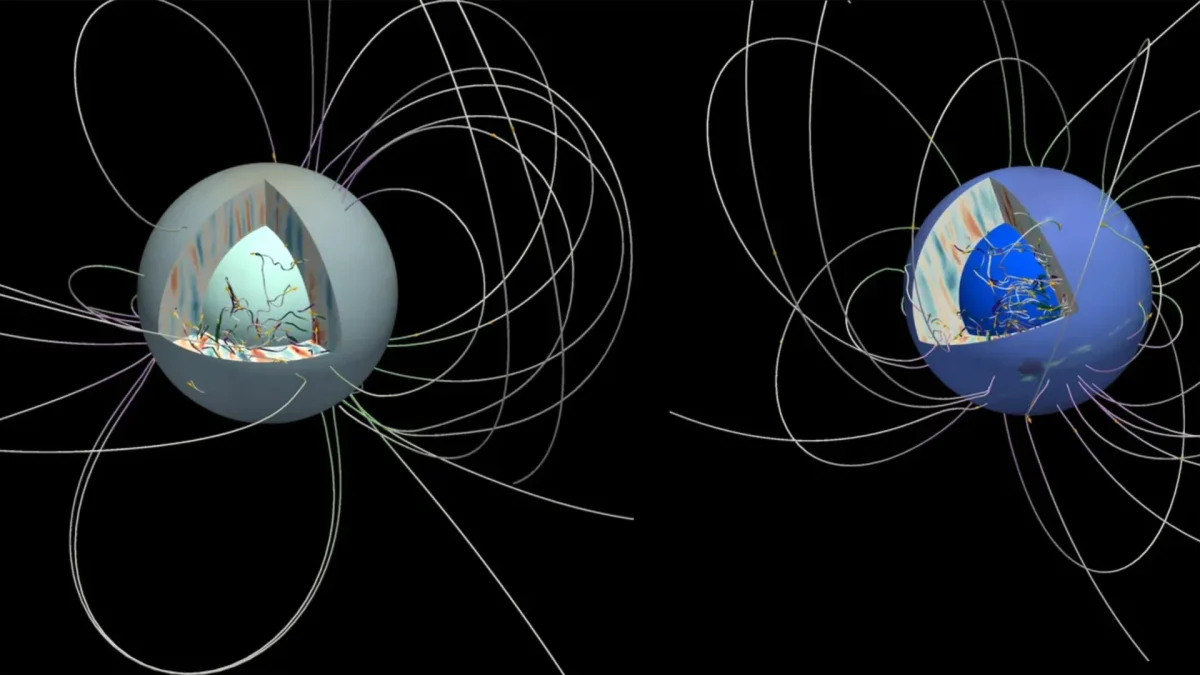
Voyager 2 revealed planetary mysteries
NASA's Voyager 2 spacecraft visited these distant worlds during its exploration in the 1980s. The mission discovered that both planets possess strangely distorted magnetic fields unlike Earth's orderly system. Although Uranus possesses a magnetic dipole inclined at 59 degrees, Neptune shows an inclination of 47 degrees. These extreme angles have puzzled researchers for decades since the initial spacecraft flybys.
Extreme conditions alter conductivity
Researchers believe high pressures and temperatures deep inside break water molecules into ions. This process makes materials increasingly electrically conductive as depth increases within the ice giants. The study suggests these unusual electrical properties create the observed magnetic field distortions. Lead author Chi Yan from UT Jackson School of Geosciences led this collaborative effort.
Poles may shift rapidly
According to models, magnetic poles might move tens of degrees in only a few decades. This rate of change is far faster than shifts observed on Earth over similar periods. The research involved teams from UCLA, Imperial College London, and Northumbria University alongside UT Austin scientists. Findings were published in the journal Communications Physics to share with the global scientific community.
Reported by one outlet
Only one outlet has published this. Nothing here has been checked against a second report, so read it as that outlet's account and follow the link below for the original.
Reported by
1 independent outlet. Headline as published. Links open the original report.