New data challenges early universe black hole claims
A team led by Fan Zou of the University of Michigan reanalyzed X-ray and infrared data from galaxy UHZ1 to challenge previous claims of a massive black hole.
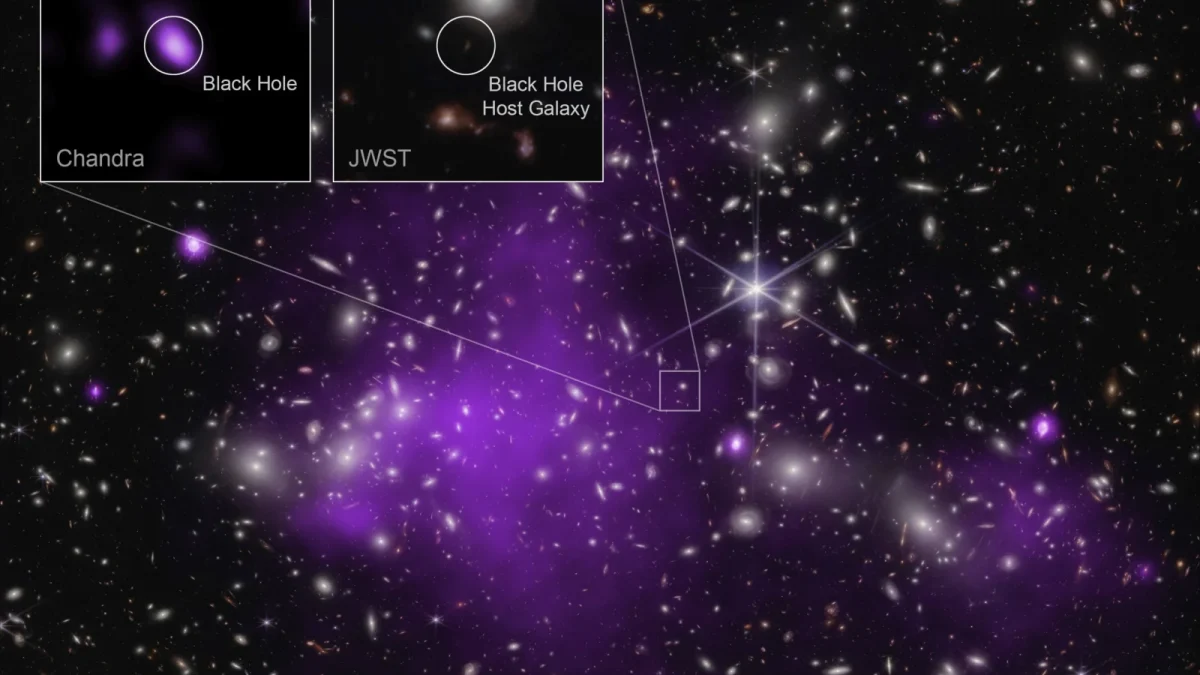
Reanalysis finds no hidden activity
The study published in The Astrophysical Journal on Oct. 14 reports no signs of hidden black hole activity within the galaxy. Researchers combined existing Chandra X-ray data with 0.95 million seconds of new observations to test earlier conclusions. This extensive reprocessing revealed a much weaker X-ray detection than originally reported by astronomers three years ago. The findings changed depending on how the X-ray image aligned with the JWST image during analysis.
Original mass estimates ruled out
Mid-infrared data from the MIRI instrument did not find the glow expected from a powerful black hole buried in dust. Scaling templates to the detection limit showed a maximum brightness 10 to 1,000 times lower than the original claim required. Astronomers detected the galaxy when the cosmos was approximately 480 million years old, corresponding to a redshift of 10. Previous estimates suggested the object weighed between 10 million and 100 million solar masses comparable to all stars in the whole galaxy.
Alternative explanations remain possible
The new evidence suggests UHZ1 could be a low-mass metal-poor star-forming galaxy rather than an active galactic nucleus. The original interpretation relied heavily on assumptions about heavy dust blocking emission from the black hole. Diagnostic features were outside the instrument wavelength range preventing direct testing at the time of the initial discovery. Independent confirmation was therefore urgently needed to validate the groundbreaking claim made by the earlier research team.
Reported by one outlet
Only one outlet has published this. Nothing here has been checked against a second report, so read it as that outlet's account and follow the link below for the original.
Reported by
1 independent outlet. Headline as published. Links open the original report.