New calculations rule out huge primordial black holes as dark matter
On November 8, 2026, Nicholas Leister and his team from the Mainz Institute for Theoretical Physics released findings in Physical Review Letters that eliminated stupendously large primordial black holes as a dark matter source.
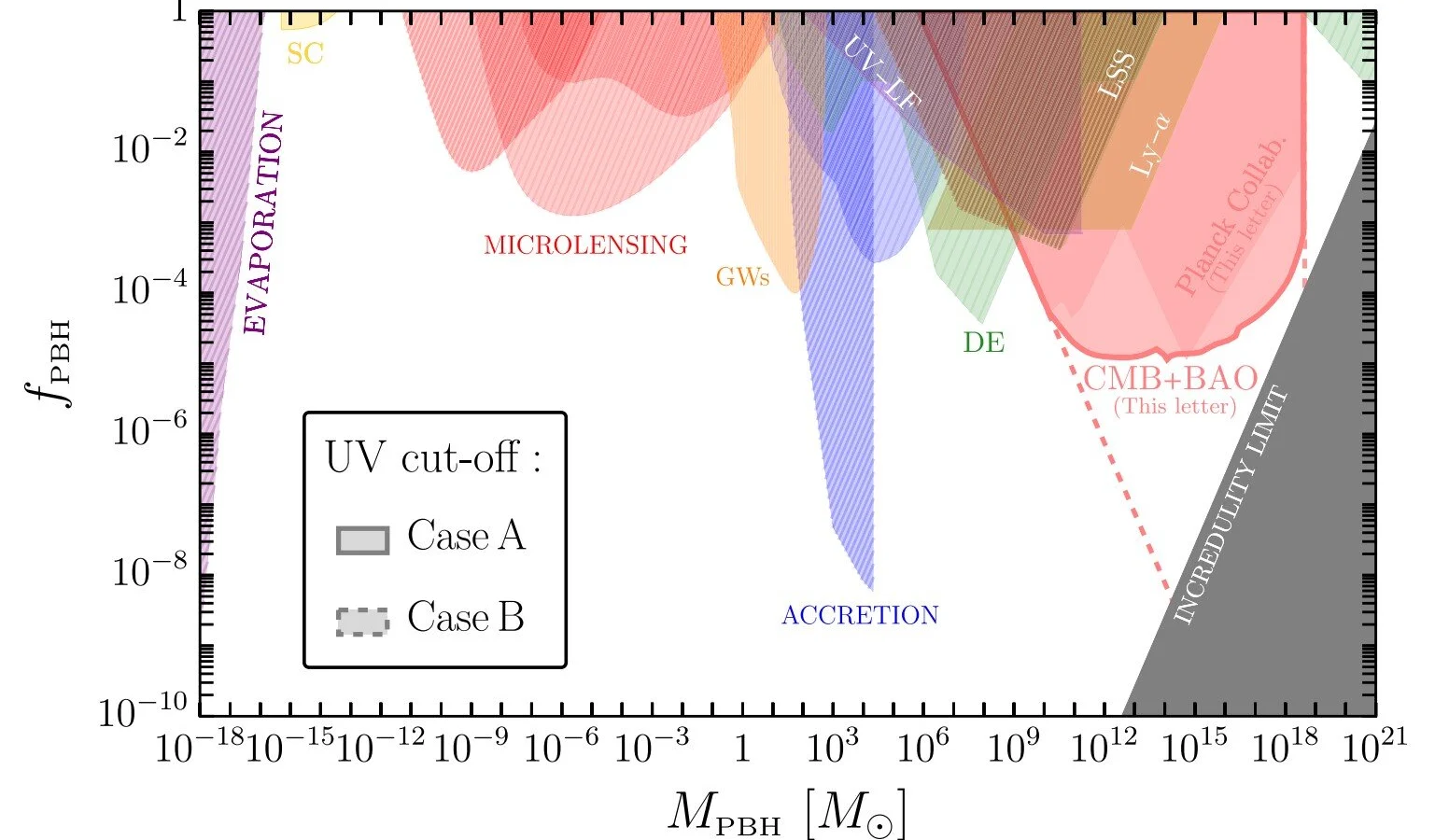
Research excludes massive black holes
Physicists previously suggested that hypothetical objects weighing at least 100 billion times the mass of the sun could explain dark matter. Nicholas Leister and colleagues from the Mainz Institute for Theoretical Physics tested this specific possibility using new calculations. Their analysis shows these immense bodies cannot make up any meaningful fraction of the universe's elusive dark matter. The study was published in Physical Review Letters on November 8, 2026.
Cosmic microwave background limits
The team assumed all black holes shared the same mass to calculate resulting variations in radiation balance. If these objects existed randomly, their scattering would create patchy patterns on the cosmic microwave background signal. Measurements of this faint afterglow from the Big Bang show no such distinctive patterns are present. Consequently, a substantial population of these heavy objects would leave the dark matter and radiation balance too uneven.
Future experiments tighten limits
The results do not rule out primordial black holes in this mass range entirely since mass ranges vary. Populations with a wide range of masses still need exploration before calculations become fully conclusive. Upcoming CMB experiments like LiteBIRD and the Simons Observatory will likely tighten these existing limits further. Researchers also hope to extend analysis to heavier black holes by searching for gravitational waves released during their formation.
Reported by one outlet
Only one outlet has published this. Nothing here has been checked against a second report, so read it as that outlet's account and follow the link below for the original.
Reported by
1 independent outlet. Headline as published. Links open the original report.