NASA Webb confirms merger of supergiant and sun-like star in Andromeda
NASA's James Webb Space Telescope confirmed a unique stellar merger between a supergiant and a smaller sun-like star in the Andromeda galaxy in 2025.
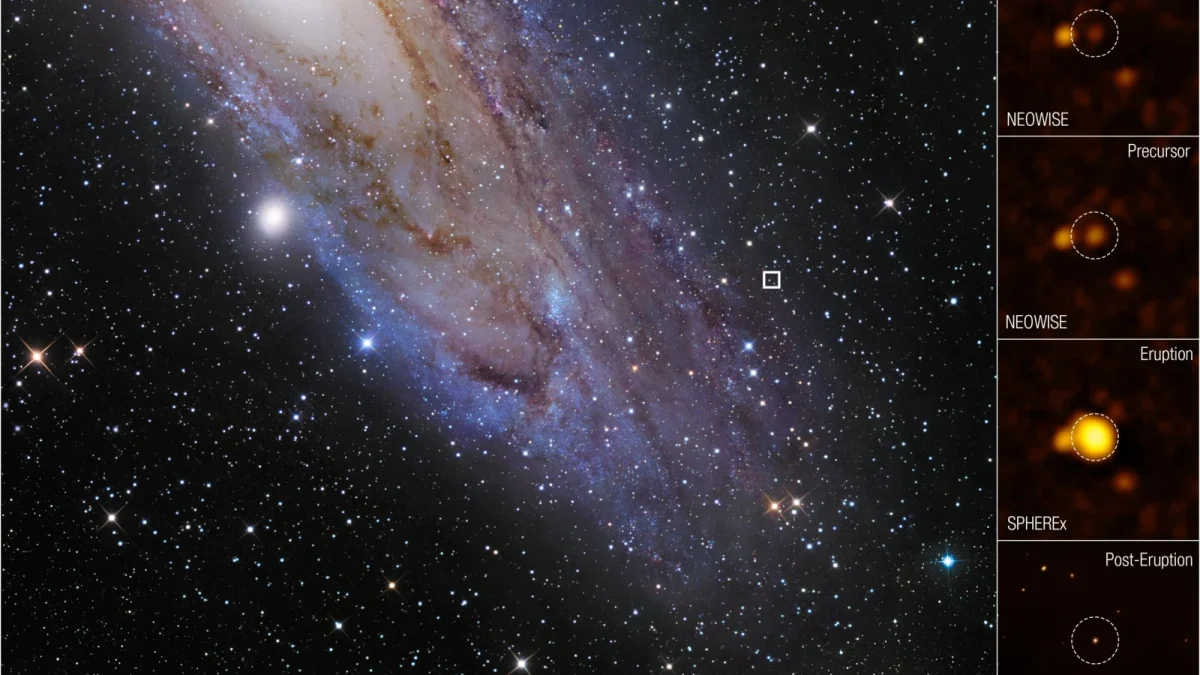
Rare event observed by telescope
Researchers identified a star slightly less massive than the sun spiraling into a puffy supergiant on Andromeda's outskirts. They nicknamed the resulting single object Bao after it merged with its companion. Quick-turn observations from NASA's James Webb Space Telescope bolstered this discovery with cross-referenced data. The team observed Bao only 47 days after the eruption peaked, marking the earliest follow-up ever. This rapid observation helped characterize the system before, during and immediately after the merger event.
Unusual speed of unification
Before transformation, the two stars spent millennia orbiting each other as a binary pair. Once contact occurred, their unification happened after only seven orbits spanning about seven years. Other known mergers of smaller stars typically occur after thousands of orbits instead. Co-author Nadia Blagorodnova noted that brightness rose quickly within a week before peaking. The primary star dwarfed the sun with seven times its mass and 350 times its radius.
Gas flows into space
As the companion orbited, it peeled off outer layers of the primary star. This gas flowed away into surrounding space during common envelope evolution. The primary star was 18,000 times brighter than the sun prior to eruption. Viraj Karambelkar stated that stellar mergers are very difficult to observe in real time. The team reconstructed events by updating simulations to match mid-infrared observations of shed dust.
Reported by one outlet
Only one outlet has published this. Nothing here has been checked against a second report, so read it as that outlet's account and follow the link below for the original.
Reported by
1 independent outlet. Headline as published. Links open the original report.