Korean team identifies nitrogen impurities blocking plastic oil recycling
A Korean research team published findings in ACS Catalysis about how specific nitrogen compounds hinder waste plastic pyrolysis oil recycling.
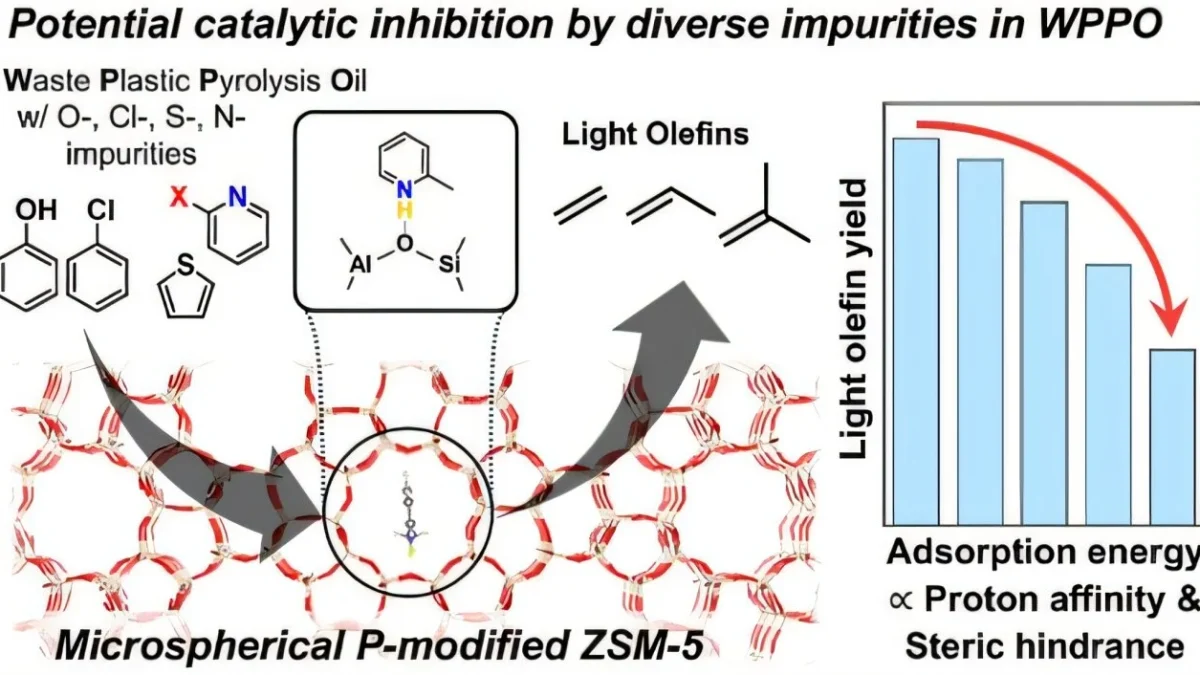
Nitrogen compounds reduce yields sharply
Researchers led by Dr. Do Kyoung Kim, working at the Korea Research Institute of Chemical Technology, examined thirteen distinct impurities found within waste plastic pyrolysis oil. They found that sulfur, chlorine, and oxygen compounds had relatively minor effects on catalytic performance during cracking reactions. However, certain nitrogen-containing compounds significantly reduced the production of light olefins needed for plastics. Specifically, 2-methylpyridine caused a pronounced drop in yield while benzonitrile had a relatively small effect on the process.
AI reveals site competition mechanism
The study utilized artificial intelligence-based computational chemistry to compare how impurities adsorb onto active sites within zeolite catalysts. Machine-learning potentials showed that nitrogen compounds occupy these active sites before hydrocarbons can undergo necessary cracking reactions. This competition leaves fewer sites available for the desired chemical transformations, resulting in reduced overall production efficiency. The team previously reported a circulating fluidized-bed technology in 2024 but noted its limits with varied feedstock compositions.
Feedstock variations complicate production
Understanding impurity effects is essential for stable production because waste plastic pyrolysis oil types vary depending on discarded plastics and additives. These recent results offer a scientific foundation for forecasting possible drops in catalytic efficiency according to levels of impurities. These results clarify that not only total nitrogen content matters but also the specific chemical forms of those compounds.
Reported by one outlet
Only one outlet has published this. Nothing here has been checked against a second report, so read it as that outlet's account and follow the link below for the original.
Reported by
1 independent outlet. Headline as published. Links open the original report.