Euclid telescope finds 15000 new strong gravitational lens candidates
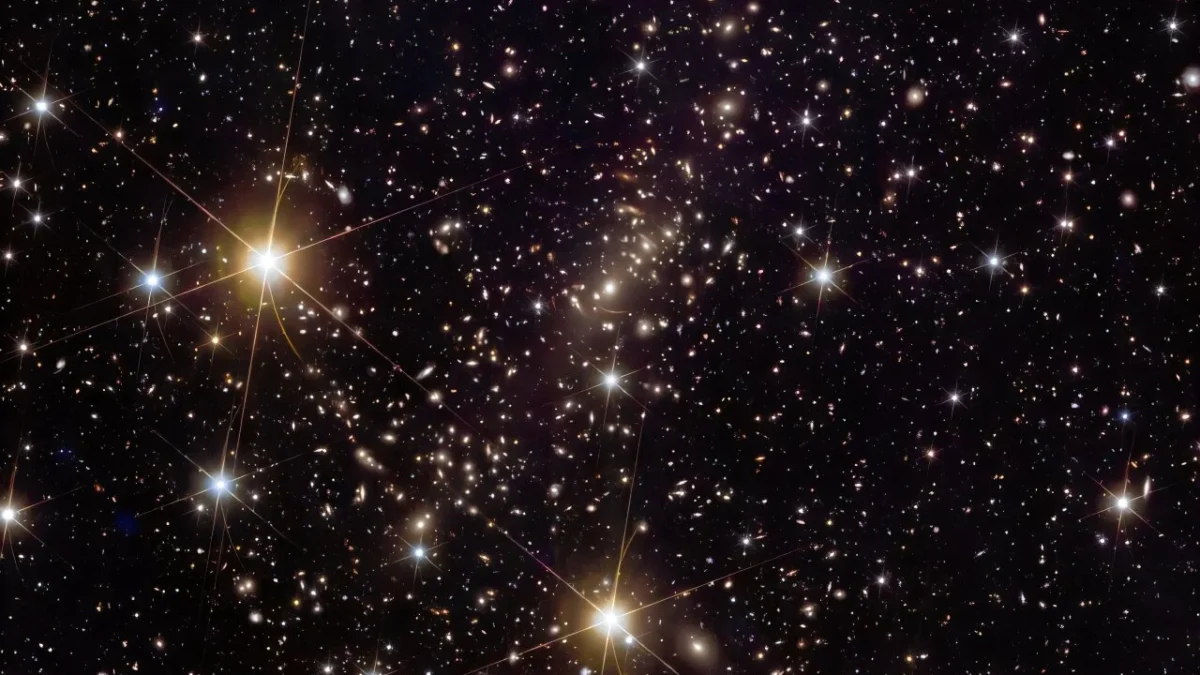
The European Space Agency's Euclid space telescope has identified 15,000 new strong gravitational lens candidates from its first data release.
First data reveals vast sky coverage
Euclid delivered its initial dataset on November 12 under the name DR-1 Foundation. This collection covers almost 5 percent of the night sky after 13 months of observation. The release contains 1.7 million gigabytes of information gathered by the spacecraft. Scientists found 900 million galaxies and 60 million quasars within this massive dataset.
Spacecraft orbits sun-Earth Lagrange point
The telescope launched in July 2023 and currently orbits the sun-Earth Lagrange point 2. This location sits roughly 1.5 million kilometers away from Earth near the sun. The instrument uses a wide-angle camera with 600 megapixels to capture visible light. It also measures redshift for about 10 billion sources out to redshift 2.
Lenses map invisible dark matter mass
Strong gravitational lenses form when massive objects magnify background sources that are otherwise too distant to see. These objects include galaxies, galaxy clusters and dark matter halos that drive the lensing effect. The phenomenon relies on total mass rather than just visible light from the object. Dr Douglas Scott notes that humans are rare while dark matter and energy dominate the universe.
Reported by one outlet
Only one outlet has published this. Nothing here has been checked against a second report, so read it as that outlet's account and follow the link below for the original.
Reported by
1 independent outlet. Headline as published. Links open the original report.