Carbon Dioxide Shapes Its Own Catalyst Surface During Conversion
Electrochemists at the University of Duisburg-Essen used computer simulations to show how carbon dioxide helps restructure its own catalyst surface to favor formic acid production.
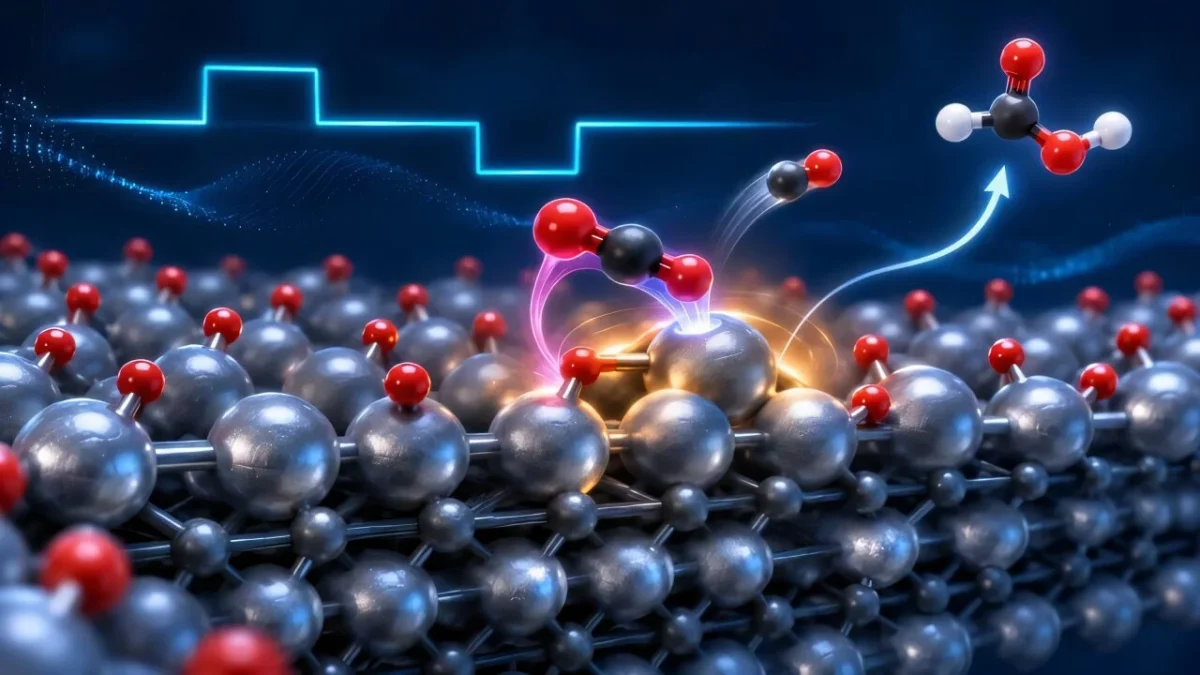
Simulations Reveal Self-Shaping Mechanism
Researchers at the University of Duisburg-Esen investigated how voltage pulses affect titanium-based MXene materials during carbon dioxide conversion. Their computer simulations indicate that carbon dioxide molecules attach to oxygen atoms after a positive voltage pulse causes titanium atoms to protrude. This specific attachment prevents unwanted hydrogen formation while allowing the gas to react effectively on the surface. A subsequent voltage pulse with reversed polarity triggers further restructuring only if carbon dioxide is actively involved in the process. During this second step, carbon monoxide detaches from the site, creating gaps that yield a different mix of chemical products.
Formic Acid Production Optimized
The calculations suggest that the restructured surface is best suited for producing formic acid among all investigated configurations. This versatile chemical feedstock could replace materials currently derived from crude oil or natural gas using electricity instead. However, if the second voltage pulse becomes too strong, the surface loses stability and begins favoring hydrogen formation again. Dr Pablo Lozano-Reis and Professor Kai S Exner led this study focusing on Ti3C2Tx material composition and atomic layer behavior. The findings were published in Advanced Functional Materials with a DOI number assigned to the specific research article.
Voltage Pulses Control Reaction Sites
Coordinating these voltage pulses allows scientists to influence both the catalyst surface structure and the distribution of final reaction products. Previous experiments with copper catalysts showed similar effects, but observing atomic-level processes remains difficult without simulation tools. The new data provides insights into how pulse sequences can be tailored for specific chemical outputs. This approach helps manage competing substances that might otherwise form simultaneously during the conversion process.
Reported by one outlet
Only one outlet has published this. Nothing here has been checked against a second report, so read it as that outlet's account and follow the link below for the original.
Reported by
1 independent outlet. Headline as published. Links open the original report.