Biodegradable bubble moves away from lactic acid without motor
Researchers at Radboud University and Durham University created a biodegradable PLA bubble that autonomously moves away from lactic acid in a new study.
Simple artificial vesicle reacts to chemical signals
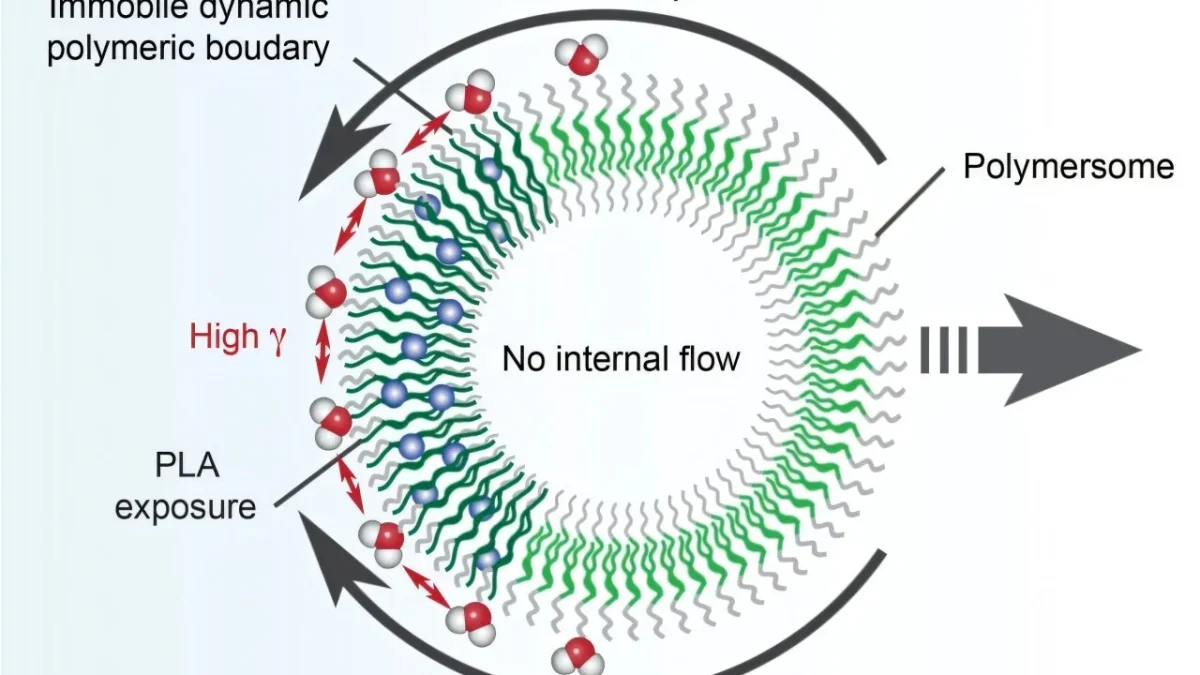
A tiny hollow sphere made of polylactic acid polymer demonstrates movement without any internal motor or external engine. The researchers state that this biodegradable bubble measures roughly 200 times less than the width of a human hair. When lactic acid accumulates on one side, the material senses the presence and pushes the particle away immediately. Living cells use complex machinery to detect chemicals but this synthetic version relies solely on its flexible skin properties.
Flexible skin creates surface flow imbalance
Lactic acid sticks to polymer chains on the bubble surface causing them to stretch out and become exposed to surrounding water. This interaction makes opposite sides of the sphere behave differently toward the liquid environment around them. The resulting imbalance generates a tiny flow along the surface which physically pushes the bubble away from the acid source. Rigid polystyrene bubbles cannot change their skin structure so they fail to show this specific negative chemotaxis effect.
Future drug delivery applications remain distant
Tumors and inflamed tissues produce large quantities of lactic acid making it a relevant biological signal for future research. The team published findings in Nature Chemistry noting that testing in biological or medical settings is still far away. Daniela Wilson led the work while colleagues from Durham University contributed to the project design and execution. This simple method helps understand how molecular shape changes drive movement similar to natural cellular processes.
Reported by one outlet
Only one outlet has published this. Nothing here has been checked against a second report, so read it as that outlet's account and follow the link below for the original.
Reported by
1 independent outlet. Headline as published. Links open the original report.