Astronomers find white dwarf star with two debris rings
Researchers using Chile's Very Large Telescope observed a white dwarf named J1328-1450 in Virgo that possesses two distinct rings of planetary debris.
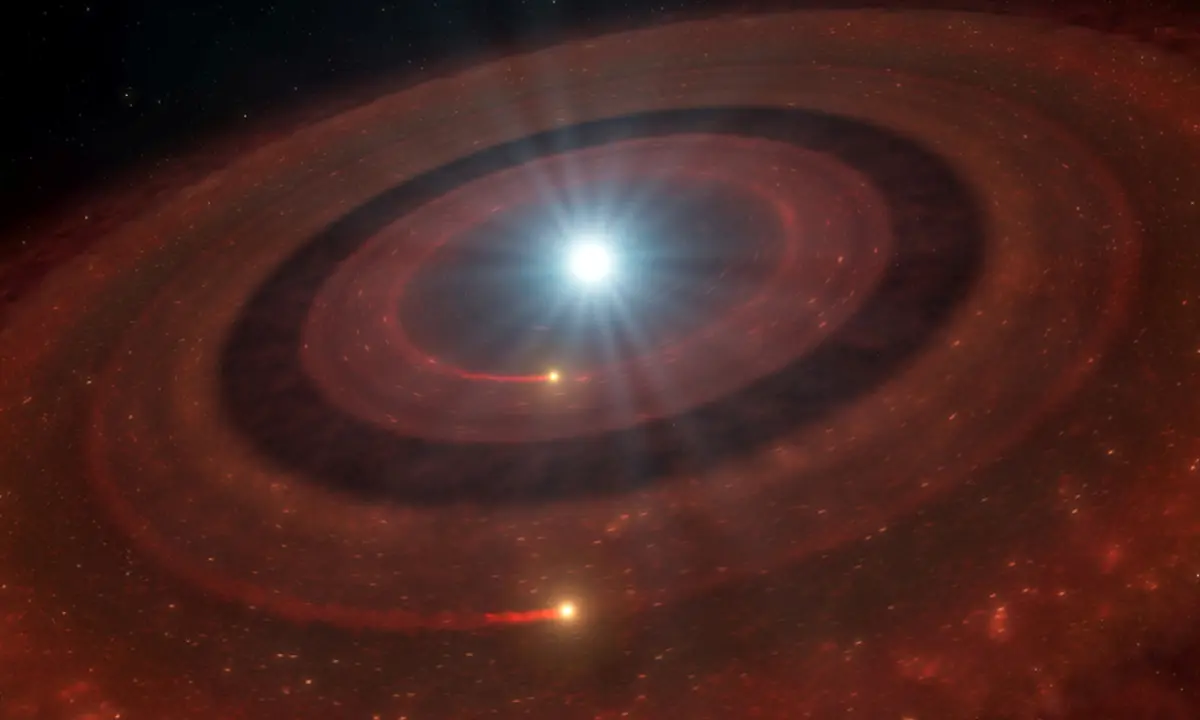
Discovery of double ring system
The white dwarf J1328-1450 lies roughly 1,600 light-years from Earth within the constellation Virgo. Observations made with the European Southern Observatory's Very Large Telescope revealed a debris disc composed of two separate rings. This configuration differs from previous findings where astronomers identified only 21 white dwarfs with single discs surrounding them. The new data suggests remnants of a planetary system retain a much more complex structure than scientists previously thought.
Formation and survival of bodies
Felipe Lagos-Vilches from Universidad Técnica Federico Santa María explained that two rocky bodies likely shaped the disc after surviving the star's violent death. One surviving object may be around the size of Pluto while the other is smaller than that. The outer ring shows strong depletion in magnesium compared with the inner ring, suggesting different parent origins. These large bodies prevented the material from spreading into a single uniform disc instead creating concentric gaseous rings.
Future of our solar system
In about 5 billion years, the sun will become a red giant and shed its outer layers. Some planets in our solar system would be destroyed while others might survive this transformation process. The white dwarf has a mass about 47 percent that of the sun jam-packed into an Earth-sized diameter. This discovery provides further support to the idea that planetary rocky bodies may survive the transformation of a star.
All 2 outlets report consistently
No differences in figures, names or dates across these reports.
- Express Tribune
- Dawn
Reported by
2 independent outlets. Headlines as published. Links open the original report.