Nobel Prize honors control over Life-Saving molecular versions
The chemistry award celebrates a breakthrough that allows scientists to control the creation of specific molecular versions, which is essential for developing safer and more effective pharmaceutical drugs.
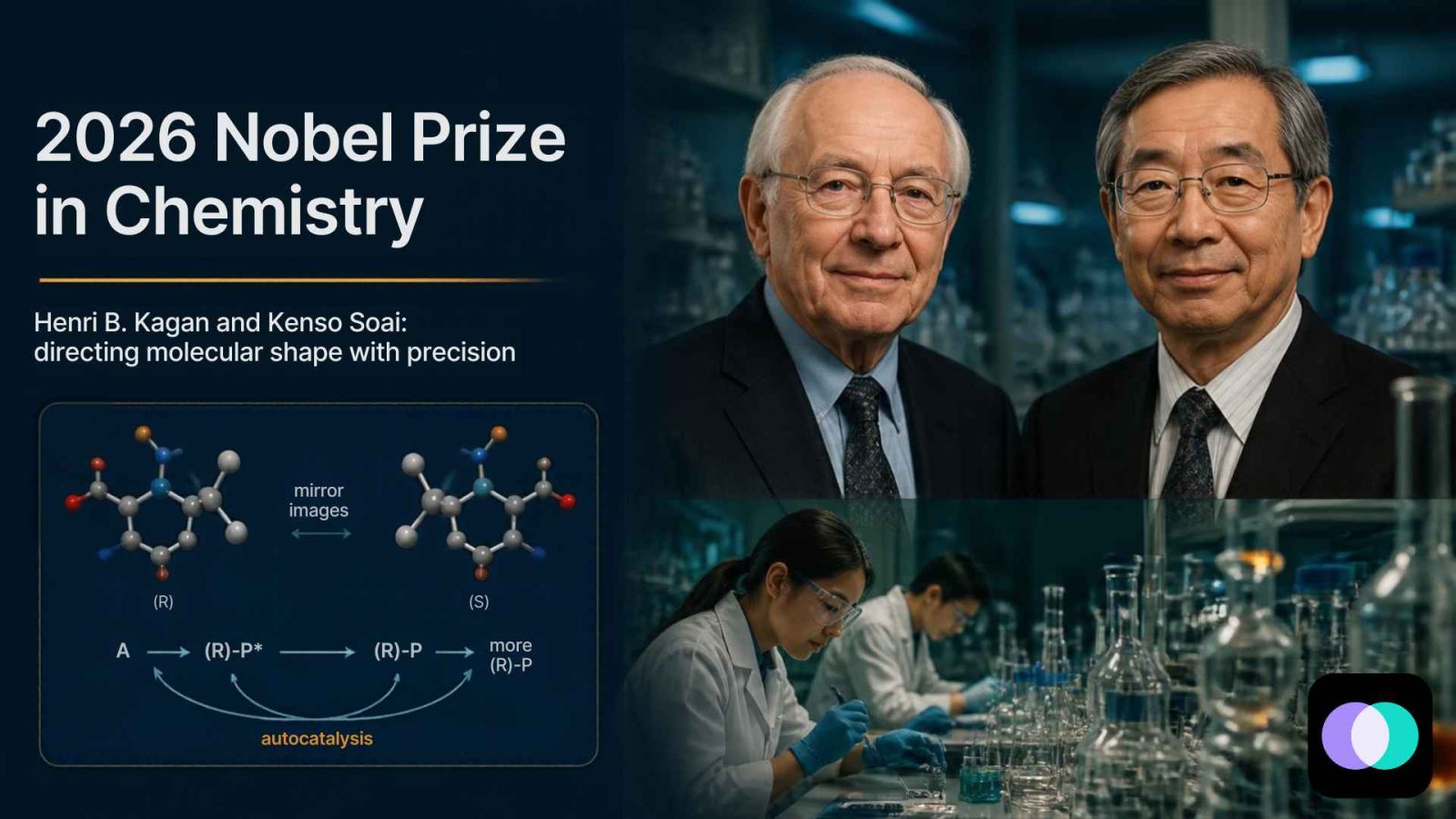
The Royal Swedish Academy of Sciences has awarded the 2026 Nobel Prize in Chemistry to Henri B. Kagan and Kenso Soai. Their work solves a mystery that has puzzled chemists for over a century regarding how molecules form specific shapes. This achievement marks a shift from understanding natural patterns to actively directing chemical outcomes with precision. The prize recognizes their discovery of non-linear effects and autocatalysis in asymmetric organic synthesis. These findings provide the tools needed to build molecules exactly as required for medical use.
Many molecules exist in two different versions that act like mirror images of each other. Scientists call these chiral molecules because the term comes from the Greek word for hand. Human hands are mirror images but cannot be placed perfectly on top of one another. Molecules behave in the same way and often require only one specific version to function correctly. The wrong version can cause a drug to fail or even harm the patient taking it.
Heiner Linke, Chair of the Nobel Committee for Chemistry, explained that this year is about foundational chemistry. He noted that many molecules occur in two different versions that look alike but are not identical. The committee praised Kagan and Soai for providing a solution to how homochirality can emerge spontaneously. Their chemical reactions are spectacular because they allow scientists to choose which version of a molecule to create. This control is the key difference between random chemical processes and targeted medical treatments.
The ability to select a single molecular version is vital for modern medicine and pharmacology. Last year, three scientists won the chemistry Nobel for developing metal-organic frameworks that trap greenhouse gases. Those structures help tackle climate change by capturing vast quantities of gas inside porous materials. This year focuses on the internal structure of individual molecules rather than large-scale material construction. The impact on drug safety is direct because doctors need only one mirror image to treat a disease.
Kagan is ninety-five years old and works at Universite Paris-Sud in Orsay, France. Soai is seventy-six years old and is affiliated with the Tokyo University of Science in Japan. Their ages show that fundamental research takes decades to mature before it wins such high honors. The award follows those for medicine and physics announced on Monday and Tuesday during Nobel week. This sequence highlights how different scientific fields build upon one another over time.
Alfred Nobel established the prizes in his will as a businessman who invented dynamite and other items tied to warfare. The chemistry awards have recognized many influential discoveries such as nuclear fission and genetic sequencing techniques since 1901. Some interruptions occurred mostly due to world wars when the awards were not given. The prize money this year is twelve million Swedish kronor or about one point two million dollars. This sum applies whether the award goes to an individual or a small group of laureates.
Opponents might argue that focusing on molecular versions ignores larger environmental challenges like climate change. They could claim that metal-organic frameworks are more urgent because they address global warming directly. However, solving the mystery of homochirality is just as foundational for human survival and health. Without safe drugs, environmental progress cannot sustain a healthy population to enjoy cleaner air. Both types of research are necessary but serve different immediate needs for society.
The chemistry reactions developed by Kagan and Soai allow scientists to manipulate chemical reactions with unprecedented control. This capability ensures that pharmaceutical companies can produce drugs without creating harmful byproducts or ineffective isomers. Regulatory bodies should encourage further investment in asymmetric organic synthesis to lower drug development costs. Governments must support research that bridges the gap between theoretical chemistry and practical medical applications.
The literature prize is set to be awarded Thursday after the physics award on Tuesday. The peace prize follows Friday before the Economic Sciences announcement on Monday completes the week. This schedule shows how the Nobel institution manages its calendar with careful attention to tradition. The chemistry laureates will receive their medals from Sweden's King during a formal ceremony in Stockholm. Their contribution ensures that future generations can rely on medicines designed with molecular precision.